.svg)
How To: Creating A Landing Page That Converts
Landing pages aim to convert visitors into regular customers. If you're not seeing the bump in sales you're hoping for from your marketing efforts; it may be time to look at your landing page.
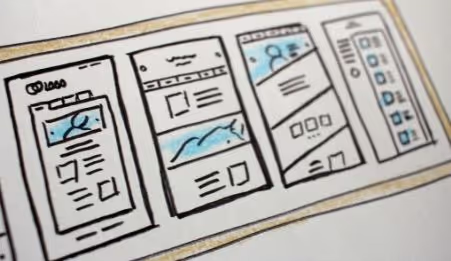
So, you’ve implemented all the relevant marketing strategies to boost your business? This includes using paid search ads and having an optimized page, resulting in more traffic to your website. However, even with more people visiting the page, you still don’t see your sales rising? This probably happens because you don’t have an appealing landing page; this is how to create one that improves your conversion rates.
Have a Call-To-Action
The call-to-action (CTA) is what you want your visitors to do once they are on your page. This could be; register, shop now, contact us or try it. CTAs aim to make your target client proceed further along the conversion channel. Note that it is crucial to foster conversions even when it’s not a daunting task.
Additionally, to make your call-to-action captivating, you need to factor in some considerations on your strategy. To remain with your visitors’ attention, ensure to keep the text simple and easy to understand. A good CTA is made of bright colors and a large button of what people should do. One way to immediately capture the attention of your visitors is by including images of people or an arrow pointing at the button.
Provide an Offer
Once you have your call-to-action, everything you include on your landing page should revolve around realizing your goal. Therefore, an offer is what your visitors receive when they fulfill your want. Incentives you can offer include coupons, discounts, or access to other features on your website. Before you decide on the offer to display, it is vital that you find out what your customers would appreciate the most through research.
What is more, you need to focus on the placement of your incentive. Ensuring that the offer does not distract your visitors from seeing the CTA would be best. Also, a mistake to avoid is coming off as demanding to your visitors by first making them click your offer before viewing your page. A good idea would be to have the offer and call-to-action side by side.

Keep it Simple
Using your landing page, you want your visitors to get more information about your company, the merits of using your product or service, and a call-to-action. Throwing all this information on your page might confuse your target audience. Without a doubt, when people have too much for them to read, it will take them more time to decide whether they should proceed with the purchasing process. It will then result in them scrolling by your page. This said, to ensure that your visitors do want to want, make the information you provide on your page clear and straightforward.
Note that, to ensure that your copy is concise, only have relevant information on the page. If you decide to list the merits of your product or service, state them in point form to make your reader want to know more.
Consider Your Target Audience
When deciding on the information present on your landing page, it would be best to know that the target audience is the reason for the effort you are putting in your creation. Note that your visitors will judge you based on the call-to-action you present to them. With this in mind, it is critical that you check on the graphics you use and the tone to get the best results.
To help you with this quest, it would be best to consider A/B testing. This model enables you to test out two different landing page layouts to help you determine which would be forth good results for your business. If you try one format and see that your visitors are not receptive to it, change some aspects in it, such as the tone or graphics and see your conversion rates go up.
Have Neat Visuals
Once visitors are on your page, you don’t want to sabotage this by having many visuals on it. There are many ways to help your customers know about what you provide. This can be through illustrations, images, or showing them how the product or service works. To help you know which is the best to implement, it would help to do a test.
In addition, if you decide on your visuals, you need to ensure that they aren’t too many to distract your visitors from taking the action you need them to. Also, ensure that the images do not take too long to load, as this will discourage your visitors from proceeding.
This said, an effective way to capture your readers’ attention is using suitable tone graphics and being precise on the information you present. When coming up with any piece of data, understand that your target audience will scrutinize it, and thus your focus should be on impressing them to guarantee more conversions.

.svg)





Start Growing Your Dental Practice with SEO
Take the first step toward transforming your marketing. Whether you’re looking to boost engagement, improve your online presence, or grow your business, our team at Vix Media Group is here to help.
Let’s craft a strategy tailored to your goals.