.svg)
The Website Was Ready to Launch. The Go-to-Market System Was Not
The site was ready while the commercial handoffs were still unresolved
We reached a launch-stage review where the website could go live, but the operating checklist still showed unresolved owners for phone routing, lead automation, CRM stages, sales coverage, and content distribution. The site was ready as a customer-facing asset. The go-to-market system around it was not.
Our website development services treat the website as one conversion surface inside a larger commercial system. Publication can give a brand a credible place to explain its offer and capture demand. It does not independently create qualified demand, assign sales ownership, preserve attribution, or follow up with a prospect.
We see this as a recurring launch-stage pattern, not a universal law. The useful lesson is narrower: teams need to define readiness beyond design approval and deployment status.
Why did the launch checklist give us the wrong sense of completion?
The original checklist was organized around the visible artifact. Pages had copy, layouts, forms, and a deployment date. That made the website easy to inspect and the surrounding operations easy to postpone.
A visitor experiences the system differently. The journey can include an ad, article, referral, landing page, form, phone call, confirmation, sales response, nurture message, appointment, and later purchase. The website owns only part of that sequence.
A working page does not prove a working handoff
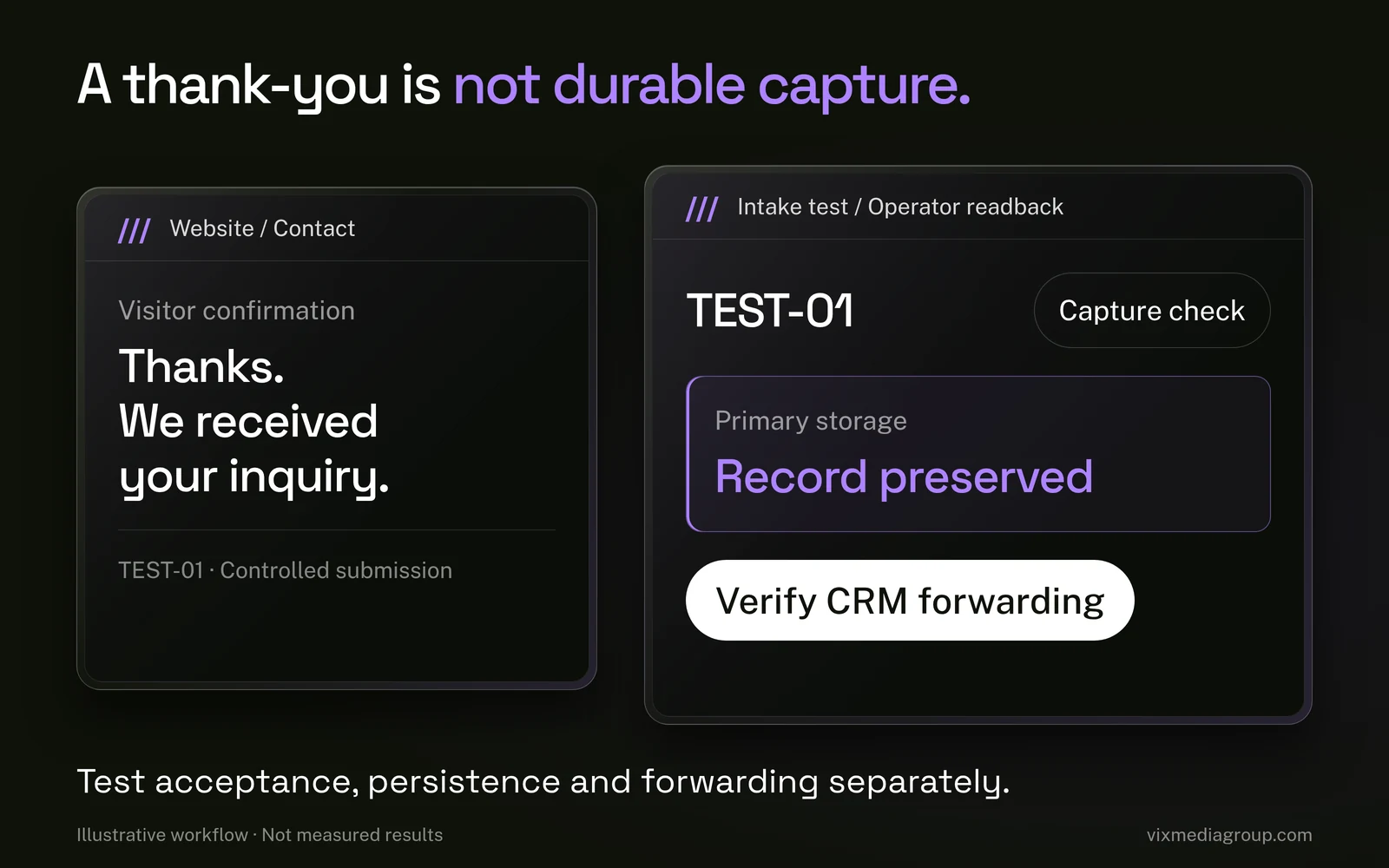
A thank-you state can appear even when the record does not persist in the intended system. A CRM can receive a contact without assigning an owner. A notification can fire without giving sales the context needed to respond. A phone number can display without a tested route or fallback.
We therefore separate visitor acceptance from durable capture, CRM forwarding, routing, and readback. Each layer needs its own expected result. “The form worked” is too broad to be an acceptance criterion.
Our content operations model adds another part of the same lesson. Publishing capacity needs ownership, review, distribution, and measurement after the page is live. A content calendar alone is not a go-to-market system.
What belongs in a complete go-to-market system?
We map the go-to-market system as eight connected operating layers. Eight is a practical architecture for the review, not a claim that every business must use an identical model.
- Market and audience position defines who the offer serves and why the choice matters.
- Demand generation creates routes to discovery through paid, organic, earned, partner, or direct channels.
- Conversion surfaces help people evaluate the offer and take a measurable next step.
- Durable capture preserves the inquiry in an approved system of record.
- Response routing gives the record an owner, deadline, escalation path, and fallback.
- Nurture adapts communication to lifecycle stage and observed behavior.
- Sales ownership carries qualification through a defined outcome.
- Revenue feedback returns later evidence to acquisition and planning.
A gap in one layer can distort the others. More traffic does not repair a form that loses inquiries. A working form does not solve slow response. A CRM record does not solve unclear ownership. A closed deal does not improve acquisition if the source and economics never return to reporting.
How do we turn “ready” into an operating decision?
We give every launch component five fields: status, owner, acceptance test, fallback, and blocker level. The format forces the team to define what success looks like and what happens when the preferred path fails.
Status needs more detail than open or done
We use states such as not started, configured, tested, accepted, and monitored. A configured integration is not a tested integration. A tested path is not accepted until the responsible owner reviews the evidence.
Ownership needs a named role and a fallback
A shared inbox is a destination, not necessarily an owner. The readiness record identifies the person or role responsible for the next action, the response standard, and the escalation path when that owner is unavailable.
Acceptance tests need observable results
For lead capture, we verify that the primary submission path accepts the inquiry, the record persists, required fields and permitted attribution arrive, routing fires, and an approved readback confirms the result. We test duplicate behavior, notification failure, and fallback handling without exposing internal details to the visitor.
Blocker levels need consequences
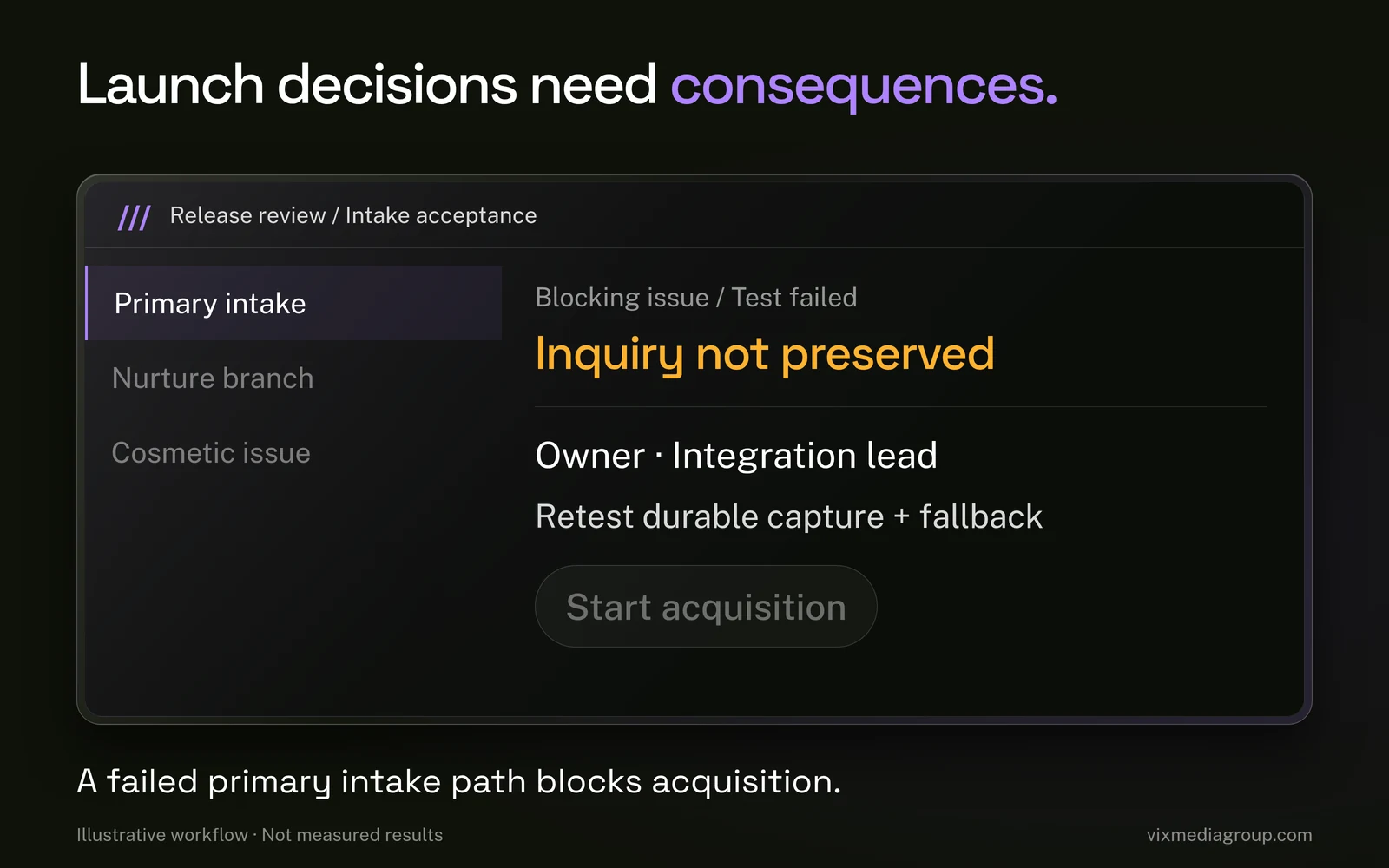
A cosmetic issue can enter the post-launch backlog. A failed primary intake path blocks acquisition. A missing nurture branch may limit scale rather than block the website itself. Naming the consequence prevents every open item from being treated as equally urgent.
Demand and authority need plans beyond launch day
A new site can explain an offer and provide a conversion path. It still needs distribution.
Paid acquisition can create controlled opportunities to test a market, message, and offer. Search, public relations, founder content, partnerships, and social distribution can create additional routes to discovery and authority over time. These channels should share positioning and measurement rather than behave like separate launches.
Our pay-per-click advertising services support bounded demand tests. Our search engine optimization services connect site structure and sustained content to discoverability. Our public relations services help turn credible evidence into earned visibility.
None of those channels guarantees demand. Each gives the team a different way to create, capture, or compound attention. The go-to-market plan states what job each channel performs and how its evidence returns to the same operating review.
What happens after a lead arrives?
The handoff needs a defined lifecycle. HubSpot's guidance on lifecycle stages illustrates the value of moving contacts and companies through named stages. We apply the operating principle regardless of CRM: define the stage, entry condition, owner, next action, and exit condition.
A useful lifecycle separates at least these questions:
- Did the inquiry enter the approved system of record?
- Did an owner attempt the first response within the agreed standard?
- Did the person reply or complete the next step?
- Did sales determine fit according to a written definition?
- Did the opportunity schedule and attend the relevant event?
- Did the outcome close, defer, disqualify, cancel, or reverse?
Our form fill to sale attribution framework maps how those stages become evidence. The purpose is not to force every journey into a perfect narrative. It is to identify where records disappear, definitions change, or ownership stops.
What should the follow-up system do before traffic scales?
The follow-up system should preserve intent, route work, adapt to behavior, and stop when the contact's state changes. It should not send the same sequence to every record indefinitely.
Before scale, we test first response, CRM ownership, email nurture, eligible SMS workflows, retargeting exclusions, optional direct mail logic, and lost-lead recovery where the economics and data context support them. We also test replies, bookings, missed appointments, intake starts, opt-outs, duplicates, and delivery failures.
Our seven follow-up systems are a Vix readiness framework for this work, not a scientifically established optimum. The framework helps the launch team expose missing ownership and suppression before acquisition volume increases.
What does launch week look like when the system is connected?
Launch week becomes a controlled operating test. The team verifies pages, forms, phone routes, CRM records, notifications, ownership queues, campaign destinations, analytics events, and fallback contacts.
We use three review windows:
- Prelaunch acceptance confirms that controlled tests reach the expected systems and owners.
- Launch monitoring confirms that real interactions follow the tested paths without exposing personal details in shared records.
- Post-launch inspection reviews lead quality, response timing, stage progression, search terms, objections, and tracking exceptions.
The third window matters because real behavior can expose problems that staging cannot. Search terms may reveal a positioning gap. Calls may surface an objection missing from the page. Sales may discover that a stage is too broad to guide a next action. Early evidence should update the message, routing, content plan, and enablement.
What happened next can be reported only as operating progress
The available internal record supports the launch-stage pattern and the unresolved workstreams. It does not establish that completing those workstreams caused demand, revenue, or a positive return.
We can document what the checklist exposed and how we structure readiness. We cannot invent an ending where integration automatically produced growth. Market demand, offer strength, competition, budget, sales capacity, conversion delay, and execution all affect what follows.
That evidence boundary improves the launch review. The team can celebrate a successful deployment without treating deployment as proof of commercial success.
What would we do differently before the next website launch?
We would open the go-to-market readiness record before design reaches final approval. Waiting until launch week compresses commercial decisions into a technical deadline.
Our preferred sequence is:
- Define the audience, offer, decision path, and measurement model.
- Assign owners for demand, capture, response, nurture, sales, and reporting.
- Build the website and CRM field map together.
- Test phone, form, routing, duplicate, and fallback paths.
- Prepare paid, organic, public relations, and founder distribution around one position.
- Establish lifecycle definitions and sales response standards.
- Run controlled acceptance before public acquisition begins.
- Schedule post-launch reviews with stop, fix, and scale decisions.
The first 90-day marketing ROI plan then becomes a measurement horizon, not a promise of payback. It can connect launch activity to tracking integrity, lead progression, capacity, and contribution assumptions without forcing a profitable ending by a fixed date.
How Vix completes the go-to-market system
Vix connects brand, web, acquisition, CRM, nurture, authority, attribution, and operating handoff. We have the strategy, creative, technical, and campaign capacity to keep those layers from becoming separate projects with separate definitions of success.
We do not promise that an integrated system guarantees demand or revenue. We build and test the conditions a team needs to learn responsibly, respond consistently, preserve evidence, and sustain distribution after launch day.
The website still matters. It is where the brand often makes its clearest case and asks for the next action. The go-to-market system determines whether anyone reaches that case, whether the next action survives the handoff, and whether later outcomes improve the next decision.

.svg)



Do you remember the last caption you read on Instagram last night? What was the last reel you watched on Facebook about? If you cannot answer one of these questions, you’re not alone. There's plenty of content online, from Google search results to social media posts and how-to videos and articles.




Video marketing is the future of content in the digital world, and for good reason. This type of marketing is a more enjoyable way to share your ideas and a great medium for reaching people on the go. Here are the reasons why video marketing is the future of content.

Small business owners may see SEO as an unnecessary expense but this could not be further from the truth. SEO is increasing in importance, it used to play a major role for only large and midsize businesses. Now, it is just as crucial for small businesses…

Marketing should not be done without a proper and defined plan in place. A marketing plan is crucial for larger companies because it allows you to be closer to your target audience and improves the effectiveness of your marketing. It will enable you to do research, leading to a better understanding of what people want, thus leading to better sales.

Online presence is crucial for businesses that want to sell online and industries where customer experience is a crucial factor. It is essential because it builds trust to know what a company has been up to lately and if it's expanding into new markets.
Start Growing Your Dental Practice with SEO
Take the first step toward transforming your marketing. Whether you’re looking to boost engagement, improve your online presence, or grow your business, our team at Vix Media Group is here to help.
Let’s craft a strategy tailored to your goals.