.svg)
About $3,300 in Spend Appeared Beside 77 Leads. Marketing Attribution Had More to Prove
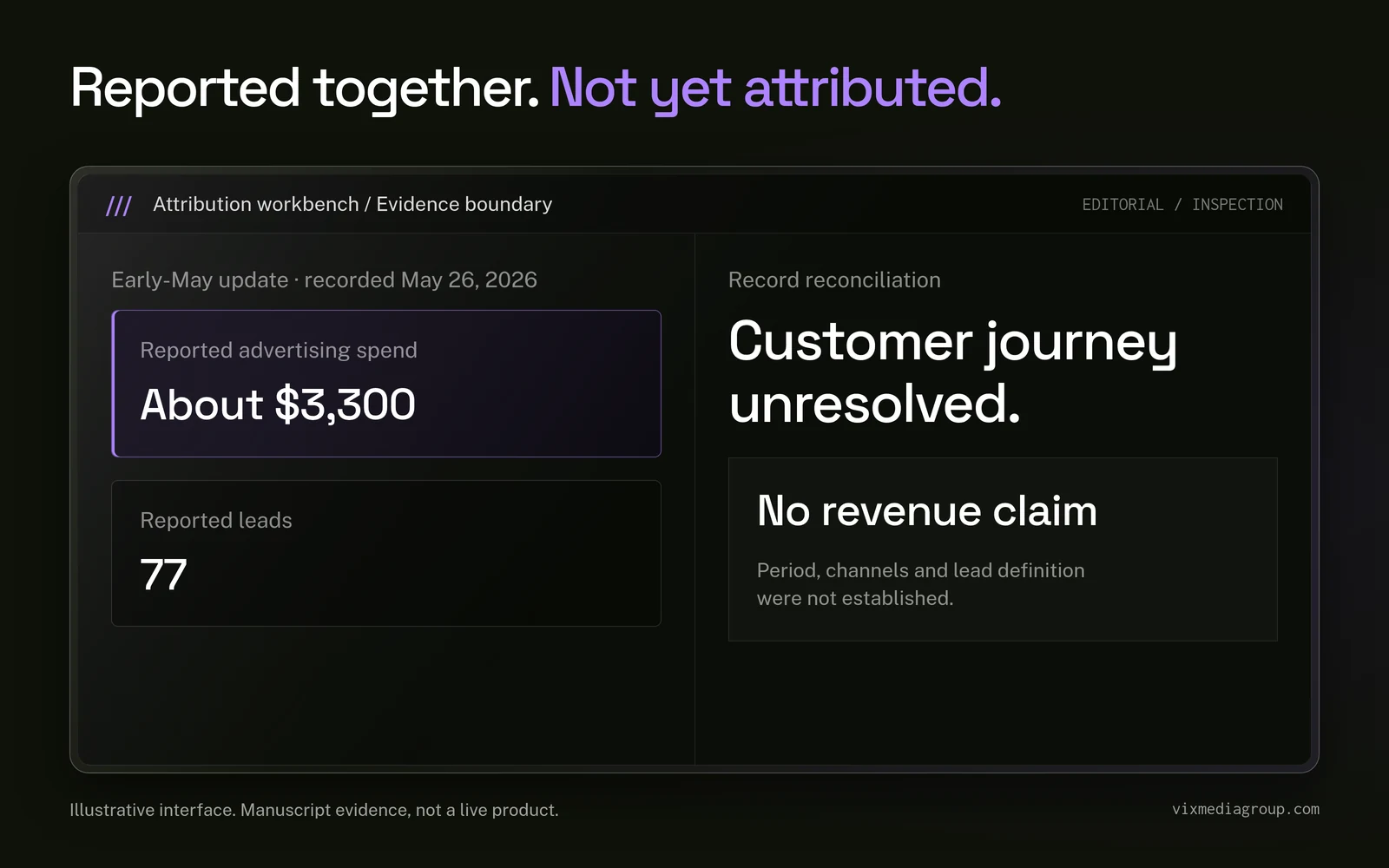
About $3,300 in spend appeared alongside 77 leads. We examined what those figures could support before treating reported activity as attribution or business return.
The marketing attribution problem began with two useful numbers
Marketing attribution starts by defining what the reported spend and lead totals can support. A May 26, 2026 client communication recorded about $3,300 in advertising spend alongside 77 leads in an early-May marketing update.
We treated the pair as an acquisition signal, not proof that the spend produced every lead or that the leads produced revenue. Our attribution tracking services begin by preserving that boundary because a reported pairing is not the same as a reconciled customer journey.
The record did not define the exact reporting dates, channel mix, lead standard, duplicate handling, qualification, appointments, or revenue. Those missing definitions determined what we had to inspect next.
What could about $3,300 and 77 leads actually tell us?
The figures told us that advertising spend and lead activity were being reported together. They gave the team a reason to trace source, receipt, response, booking, service delivery, and revenue.
They could not independently answer:
- Which channel or campaign sourced each reported lead?
- Whether every contact reached the CRM successfully?
- Which records were duplicates, invalid, or qualified?
- Which prospects received a timely response?
- Which prospects booked, attended, or purchased?
- Which outcome records could be reconciled to the original contact?
The source says roughly $3,300, so we use about rather than presenting the spend as exact. It also says 77 leads were noted, not that one defined campaign produced 77 attributable leads.
The arithmetic ratio was not a defensible qualified-lead cost
Dividing about $3,300 by 77 produces approximately $42.86. The arithmetic is straightforward, but its business meaning is not.
Without a defined numerator, denominator, and period, the ratio cannot be called a cost per qualified lead. Spend may include several channels or dates. Lead totals may include duplicates or different inquiry types. Qualification may occur later in the CRM.
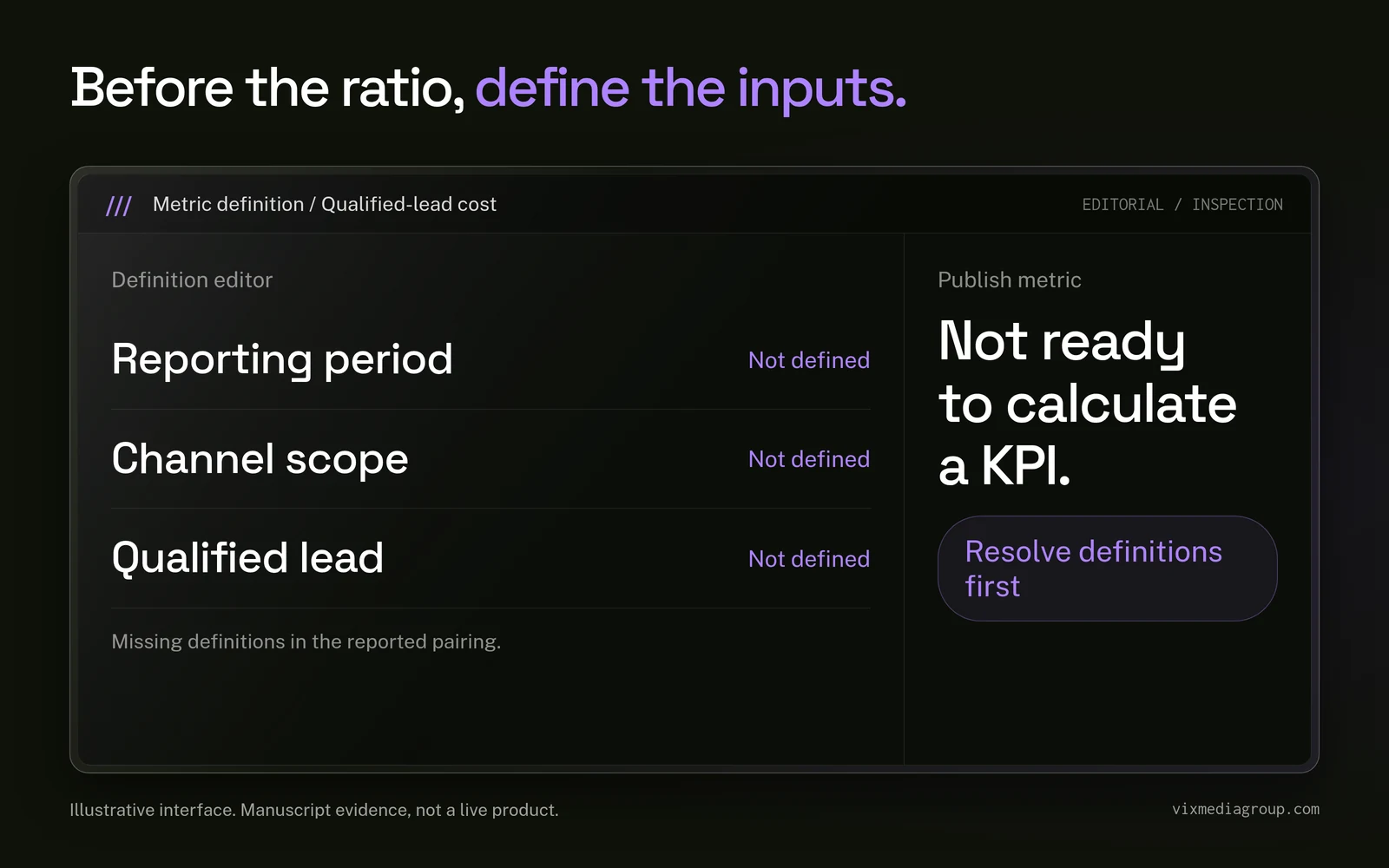
We chose not to promote the ratio as a performance result. Precision in the calculation would have hidden uncertainty in the inputs.
Why was the obvious advertising explanation incomplete?
The obvious explanation was that roughly $3,300 in ads produced 77 leads at an attractive cost. The record did not support that causal statement.
Acquisition platforms can report spend, impressions, clicks, and platform-defined conversions. The business continues the journey through contact routing, CRM stages, scheduling, fulfillment, and revenue collection.
Platform conversions and CRM leads used different boundaries
A platform conversion may represent a form submission, call, message, or another configured event. A CRM lead may represent the received contact after routing and field processing.
Those totals can differ for legitimate reasons:
- Attribution windows assign credit on different dates.
- Time zones place events in different reporting periods.
- Browsers or consent states limit identifiers.
- Duplicate rules combine several submissions into one record.
- Invalid or test records are removed downstream.
- Calls and offline contacts enter through separate paths.
A discrepancy is not automatically an error, but it must be explainable before the team treats either total as commercial truth.
The engagement was still building the downstream system
At the same time as the early-May update, the engagement was wiring GoHighLevel, email and SMS flows, carrier registration, routing, and downstream lead handling.
Those projects mattered because the 77-lead number stopped before the questions operators needed to answer. The source did not tell us whether each contact reached the right owner or moved into a defined business outcome.
Our CRM configuration work aligns lifecycle stages, required fields, source capture, ownership, and handoff rules. A lead becomes analytically useful when the team knows what the label means and can inspect the record behind it.
The data revealed a seven-checkpoint attribution chain
We mapped the journey as seven separate checkpoints. Each one could succeed or fail independently.
The checkpoints were:
- Capture campaign and source identifiers at the response.
- Confirm that the contact arrived in the CRM.
- Deduplicate records and apply the agreed lead definition.
- Record response timing and the responsible owner.
- Track qualification and booking status.
- Reconcile service delivery with the contact record.
- Connect revenue only when a defensible identifier exists.
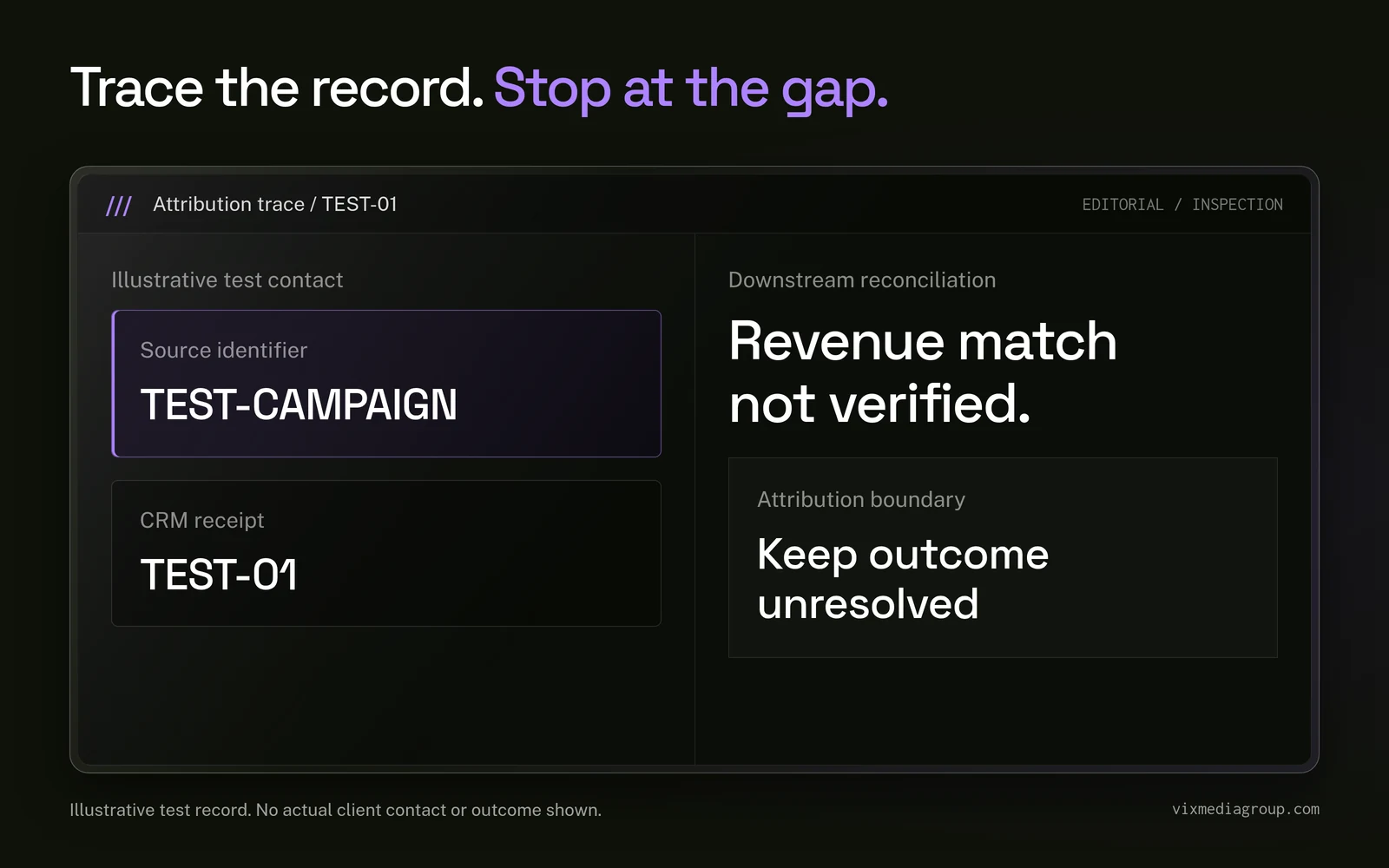
A dashboard that shows only spend and revenue can hide the handoff where the system broke. A dashboard that stops at lead volume can hide whether acquisition turned into a useful conversation.
Response workflow belonged inside the measurement model
A delayed or missing response does not change where a lead originated, but it changes the outcome available for analysis. That makes response workflow an operating variable even when it is not an acquisition metric.
Our lead nurturing services connect email and SMS follow-up to defined customer stages. Consent, carrier requirements, routing, and human ownership stay visible because automation alone does not complete the relationship.
The follow-up layer also needs status definitions. Sent, delivered, replied, booked, and purchased are different events and should not be blended into one success label.
What did we change after the early marketing update?
We moved the discussion from a top-line ratio to record-level traceability. The question became whether a contact could be followed from its source through the systems the business used to respond and deliver service.
Our operating sequence was:
- Write the reporting period and source scope before reviewing totals.
- Define lead, qualified lead, booking, completed service, and revenue.
- Preserve campaign identifiers through forms, calls, and CRM creation.
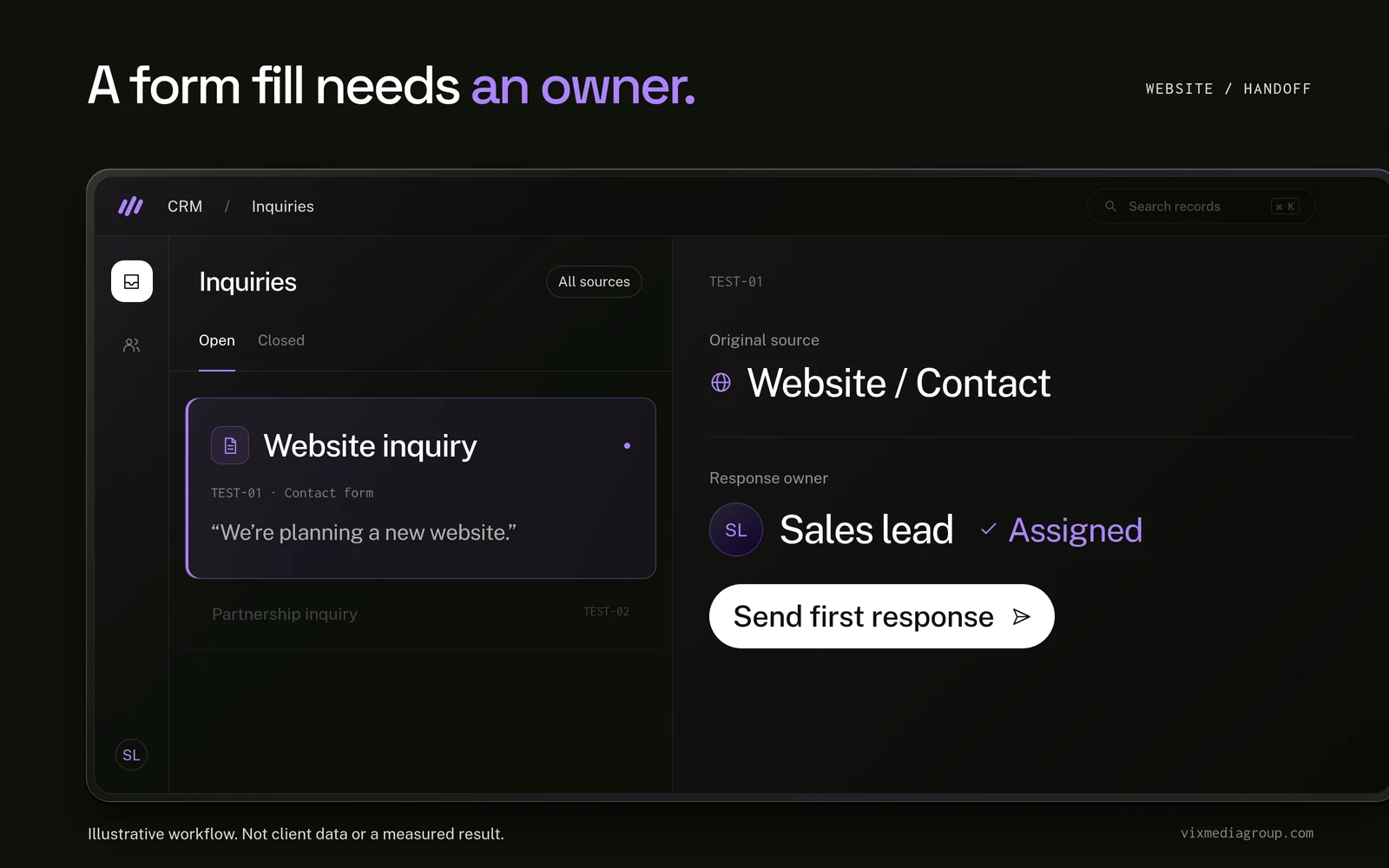
- Assign ownership and response expectations at the first handoff.
- Reconcile a sample of records across advertising, website, CRM, and scheduling.
- Document unmatched records and the reason each remained unresolved.
- Report only the outcomes supported by the available identifiers.
This approach did not guarantee perfect attribution. It created a defensible chain and showed where evidence ended.
Paid media needed outcome feedback without borrowing certainty
Campaign teams can improve decisions when eligible downstream outcomes return to the platform. The feedback still depends on accurate definitions, permissions, and matching.
Our pay-per-click management uses downstream evidence when it is available and appropriate. We do not label a platform-defined conversion as revenue or a reported lead as qualified without the record needed to support that language.
A conversion import can improve the feedback loop, but it does not replace offer strategy, creative judgment, sales operations, or human accountability.
What happened next is infrastructure context, not a revenue result
The available evidence verifies that the May 26 communication reported roughly $3,300 in advertising spend and 77 leads. It also verifies that CRM, routing, nurture, and registration work was underway around that period.
The evidence does not define the 77 leads, attribute all of them to the reported spend, or connect the group to booked services and revenue. It does not support a universal cost-per-lead benchmark.
We keep the client anonymous, and publication approval remains required for the figures. References to specific patient wins or revenue details stay outside the public story unless approval and supporting records are attached.
The defensible result was a clearer measurement requirement. We knew the acquisition signal was worth investigating, and we knew the existing summary could not finish the attribution claim.
What would we do differently before the next campaign starts?
We would write the attribution contract before the first dollar was spent. The contract would define the period, channel scope, events, lifecycle stages, identifiers, owners, and reconciliation schedule.
Our next setup would require:
- A documented definition for inquiry, lead, qualified lead, booking, and customer.
- A campaign naming and source-capture standard.
- A test submission through every active intake path.
- A CRM owner and response requirement for each route.
- A deduplication rule that preserves source history.
- A scheduling and service-delivery reconciliation method.
- A revenue connection only where identifiers and permissions support it.
- A recurring exception report for records that fail a handoff.
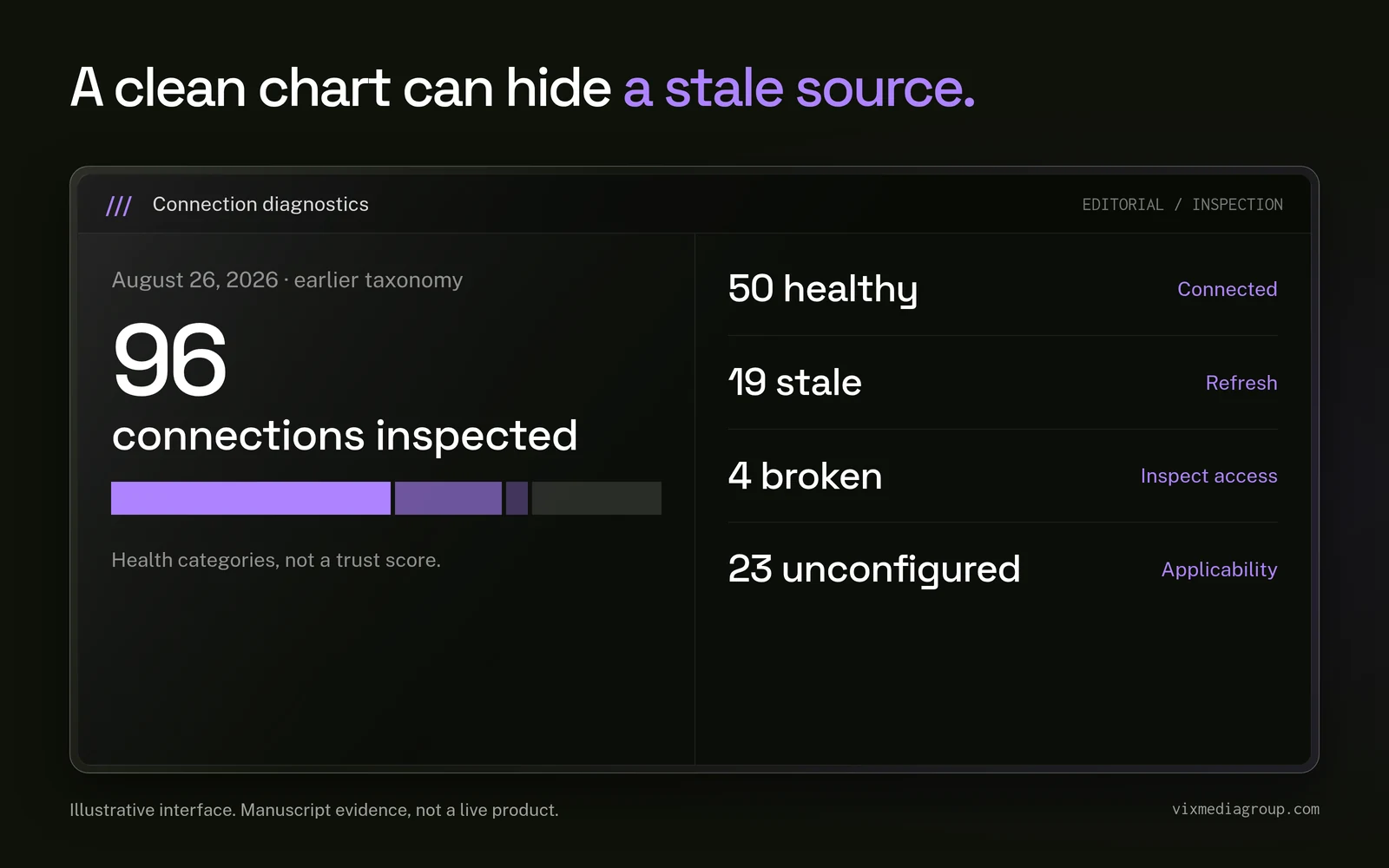
A related marketing analytics dashboard audit shows why connection health and field definitions need to stay visible. A clean report can still hide a broken source or an undefined event.
How Vix builds marketing attribution operators can use
Vix connects paid media, website intake, CRM receipt, response, booking, service delivery, and revenue without treating those events as interchangeable. The system is valuable because it shows where a journey continued, stopped, or became untraceable.
About $3,300 beside 77 leads was enough to start that investigation. It was not enough to finish it.
A useful marketing attribution system preserves both possibilities. It can identify efficient acquisition when the records support that conclusion, and it can expose lost identifiers, slow response, duplicate records, or unresolved outcomes when they do not.
The lesson was not to distrust every top-line report. It was to ask the report to carry only the claim its definitions can support. Spend is not demand, a lead is not a customer, and a matching pair of totals is not a causal chain. Operators need the records between those numbers before they can turn volume into accountable learning.

.svg)



Do you remember the last caption you read on Instagram last night? What was the last reel you watched on Facebook about? If you cannot answer one of these questions, you’re not alone. There's plenty of content online, from Google search results to social media posts and how-to videos and articles.


Start Growing Your Dental Practice with SEO
Take the first step toward transforming your marketing. Whether you’re looking to boost engagement, improve your online presence, or grow your business, our team at Vix Media Group is here to help.
Let’s craft a strategy tailored to your goals.