.svg)
We Moved 58 Articles Across Six Websites. Content Operations Made the Work Publishable
Coordinating 58 articles across six websites required clear approval, staging, scheduling, and release rules—not just finished drafts or a single completion count.
Our content operations challenge began after the drafts were written
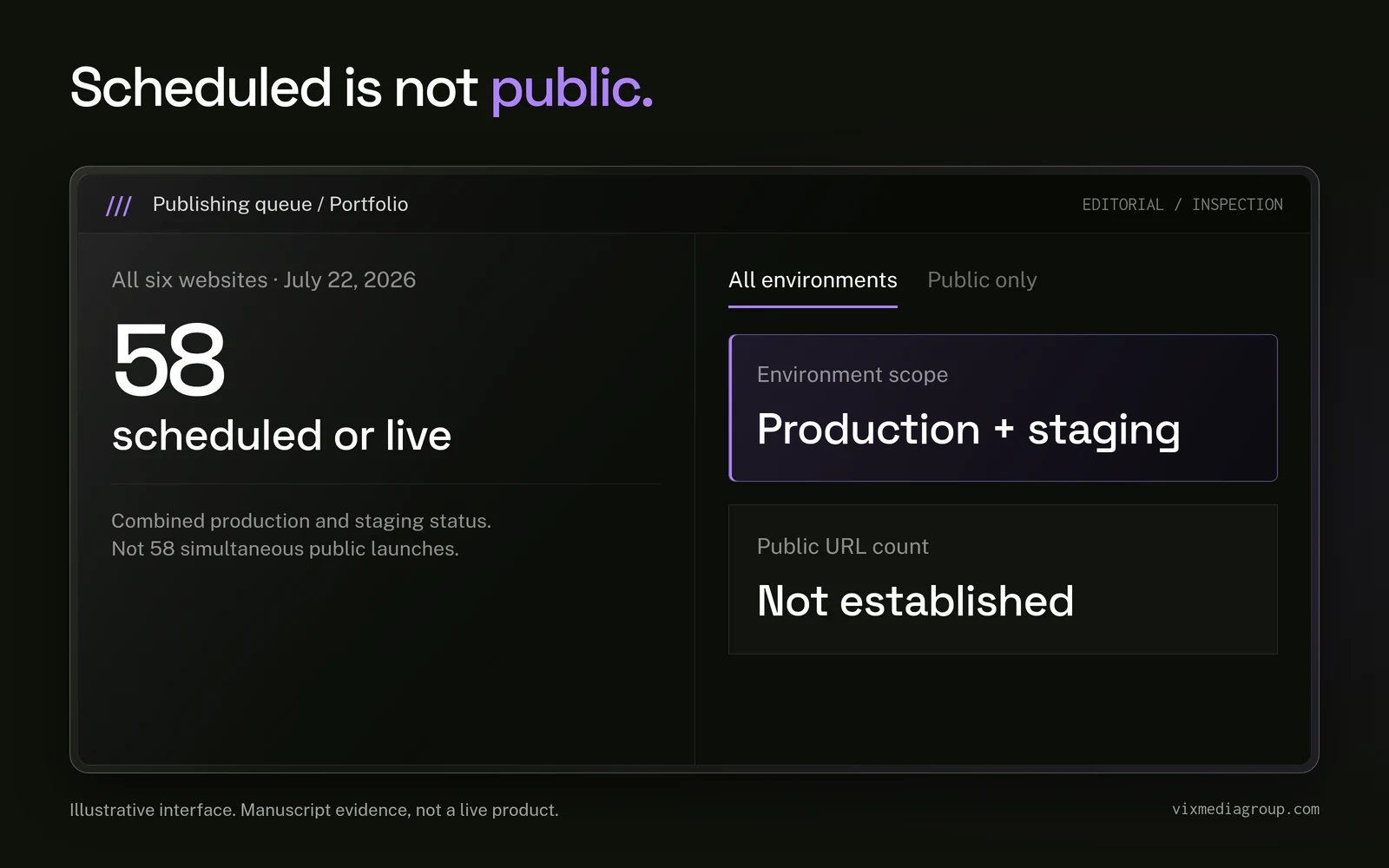
Content operations turned 58 articles into a coordinated publishing program across six websites. By July 22, 2026, all 58 were scheduled or live across production and staging for an anonymized manufacturing portfolio, but that status did not mean 58 articles were simultaneously published on public URLs.
The distinction shaped our work. Our search engine optimization services could guide topic selection and site fit, but search strategy alone could not move each article through approval, content management, templates, imagery, release, and measurement.
Writing was one production lane. The harder part was keeping six sites aligned without treating them as copies of one another.
What did scheduled or live mean across the six-site portfolio?
Scheduled or live was a workflow status covering production and staging. Some articles were already public, some were scheduled for a later date, and some were present in staging while production coordination continued.
We keep that caveat attached to the 58-article figure because a combined counter can hide meaningful differences among drafted, approved, staged, scheduled, and published work. The operating record supports portfolio-wide progress. It does not support a claim that 58 public URLs launched together.
A content total needed a shared status language
We defined the states so the client and production team could see what remained between writing and release. A completed draft was not treated as a completed publication.
The working states separated:
- Drafted content that still required review.
- Approved content ready for site entry.
- Staged content awaiting technical or visual checks.
- Scheduled content assigned to a future release.
- Live content available on the public site.
- Remediation work for pages missing a required element.
This vocabulary prevented a familiar reporting problem. A large completion number could no longer conceal missing images, unresolved templates, or a staging queue waiting for production access.
Why was the obvious scale explanation incomplete?
The obvious explanation was that the program needed a team capable of writing 58 articles. That was true but incomplete.
The portfolio required four approved content categories, six site assignments, client review, staging and production coordination, heading fixes, featured images, performance work, and post-release measurement. Those handoffs already determined whether completed writing could leave the backlog.
A shared taxonomy created boundaries before production
The client required four approved content categories. We used that taxonomy to decide which subjects belonged in the program and where each article should live.
For every proposed topic, we asked:
- Which site had the strongest subject and audience fit?
- Which approved category contained the topic without stretching its meaning?
- Which search intent could the page satisfy?
- Which related service, product, or resource should the page connect to?
The goal was not an even distribution across six domains. It was coherent topic coverage on the property that could support the article most credibly.
Our later SEO content strategy for impressions and clicks reflects the same principle. Page volume does not tell us whether content reaches the right intent or gives the visitor a useful next step.
Portfolio consistency did not require identical site voices
A shared operating system controlled status, metadata, taxonomy, and quality checks. It did not require every site to publish the same angle or sound like a duplicated brand.
We kept the production rules consistent while adapting subject emphasis to the audience and role of each property. That balance let the portfolio share infrastructure without erasing the reason each site existed.
The data revealed that technical defects were editorial blockers
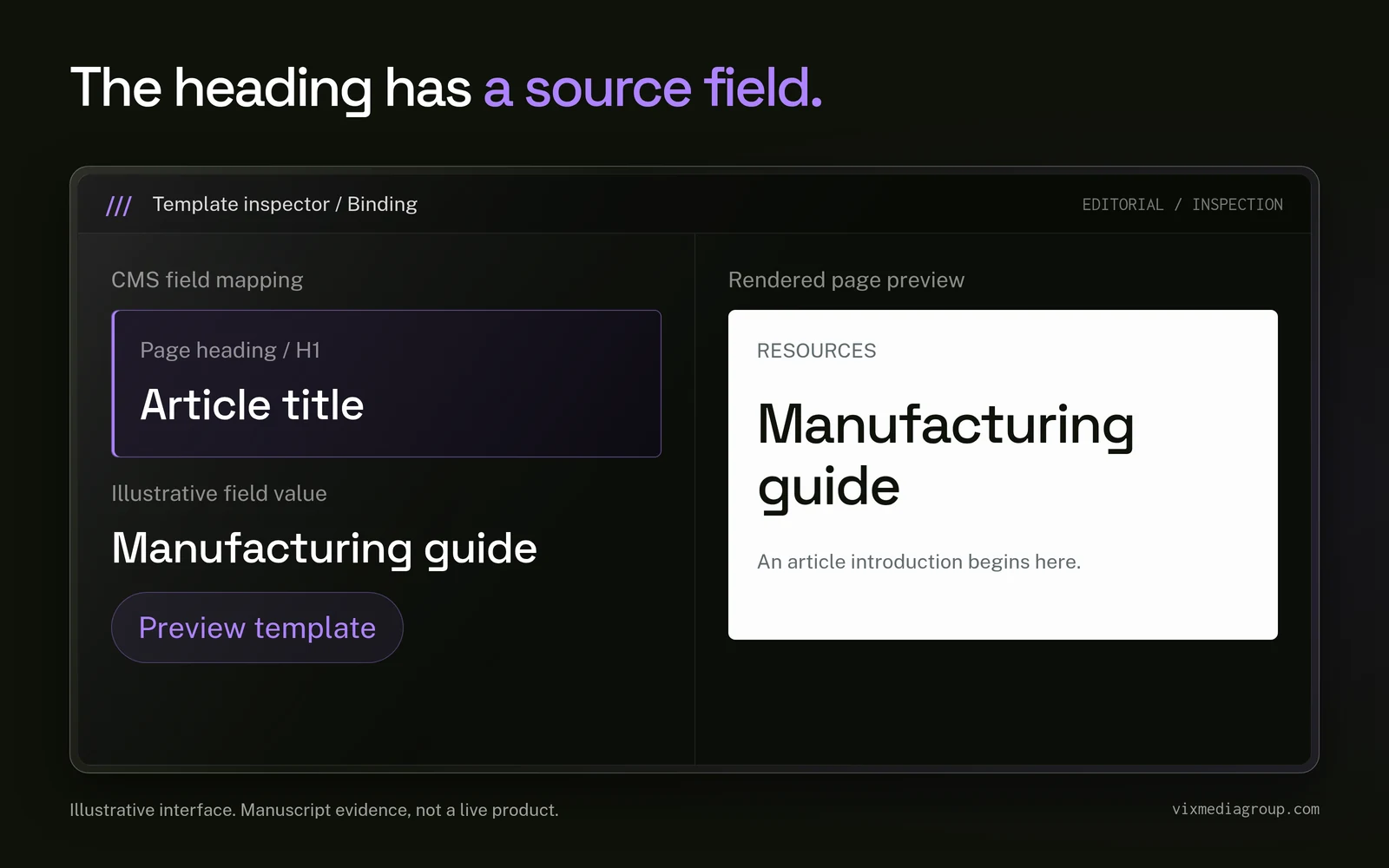
The operating records included an H1 field-mapping bug, missing H1s, and staging-to-production cadence questions affecting more than 45 scheduled posts. Those were not separate development chores. They changed whether approved articles appeared correctly when released.
A strong draft cannot repair a template that sends the wrong field into the page heading. An editorial calendar cannot guarantee publication when the route from staging to production has no shared procedure.
We treated template fields as part of the content model
We mapped the fields required for the article to render as intended, including the H1, body, category, metadata, featured image, and internal links. We then connected field-level checks to release review.
Our website development work supports this operating model because template changes and editorial decisions meet on the published page. Neither team can verify the result alone.
We also documented a production-change procedure rather than asking editors to work around recurring defects. The procedure gave the team a repeatable path for reporting, testing, approving, and releasing a fix.
Featured images had their own production and approval path
Many published posts still lacked featured images in the July 22 record. The August 5 operating notes also documented approved-photo requirements, content bundling, and performance constraints.
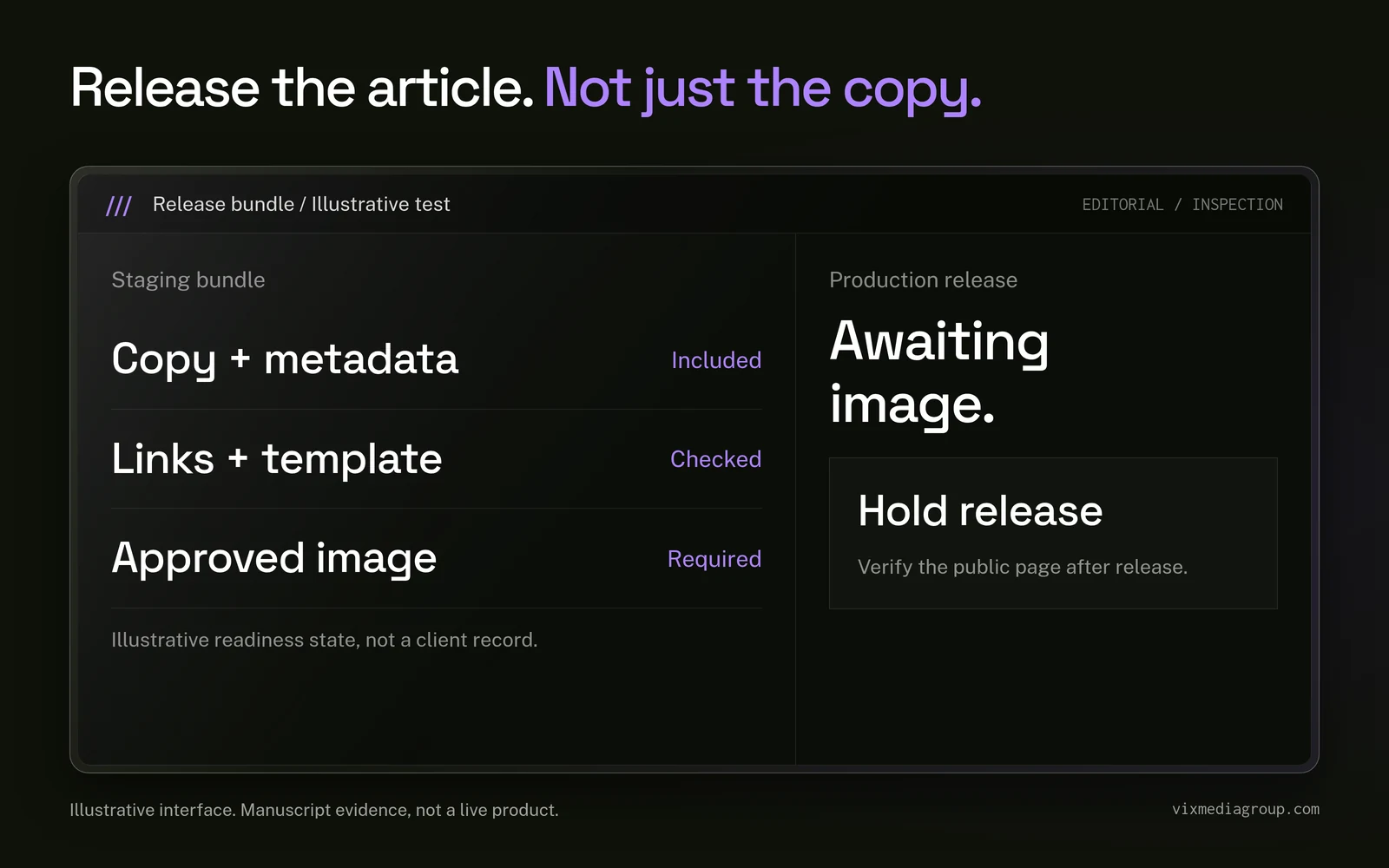
We could not treat imagery as decoration placed after publication. The image needed approval, appropriate dimensions, compression, placement, and a relationship to the article's subject.
Our graphic design services connect the visual asset to the editorial purpose while keeping page performance in view. A completed image that slows six sites or misses the approved source requirement creates another queue instead of closing one.
What did we change in the publishing workflow?
We built controlled handoffs around the article rather than moving a document directly from writer to website. Each handoff had a defined input, owner, and completion condition.
The operating sequence became:
- Approve the topic within the four-category taxonomy.
- Assign the article to the site with the strongest fit.
- Draft and review the content against the approved purpose.
- Prepare metadata, links, and an approved visual request.
- Enter and verify the article in the content management system.
- Check templates, headings, imagery, and performance in staging.
- Schedule or release the approved version to production.
- Confirm the public page and begin measurement.
This sequence did not remove coordination. It made the coordination visible enough to manage.
We bundled related work before release
Content bundling helped the team move text, imagery, metadata, and technical requirements together. That reduced the chance that a writer marked an article complete while a designer or developer discovered the requirement later.
A broader go-to-market system after a website launch uses the same operating logic. The visible asset is only one layer. Distribution, follow-up, measurement, and ownership determine whether the asset becomes part of a functioning system.
What happened next is a workflow result, not a traffic claim
By July 22, all 58 articles had reached scheduled or live status across production and staging. That is the verified result we can report.
The evidence does not establish that the program increased traffic, rankings, leads, or revenue. It also does not support saying that every article was publicly live at the same time. Some remained scheduled, staged, or visually incomplete.
We keep the six-site portfolio anonymous because the combination of scale and structure could identify the client. Publication approval is still required for the underlying program details.
The operating lesson survives those limits. Scale became possible because the team could distinguish writing progress from publication readiness and could see which handoff blocked each article.
What would we do differently on the next multi-site program?
We would lock the production model before the article queue grew. Taxonomy, template fields, image rules, staging access, and status definitions should be tested on one article per site before a large batch enters the system.
Our next setup would require:
- A shared status dictionary with one owner for each transition.
- A site assignment rule based on audience and subject fit.
- A verified field map for every content template.
- An approved image source and specification before drafting begins.
- A staging checklist that includes headings, links, imagery, and performance.
- A release calendar that distinguishes scheduled from public.
- A post-release inspection and measurement owner.
That pilot would expose differences among the six sites before 45 or more posts depended on the same assumption.
How Vix turns content operations into sustained publishing
Vix coordinates strategy, search, writing, design, development, release, and measurement as one operating system. The value is not that every specialist does more work. It is that their work arrives in the right order with a visible definition of complete.
Our framework for follow-up systems behind paid traffic explains why the same discipline matters after publication. Attention without a defined handoff can disappear between systems just as easily as an approved article can stall between staging and production.
The 58-article program did not prove a traffic or revenue outcome. It showed why we did not manage this multi-site content portfolio as a stack of documents. Every article was also a taxonomy decision, a CMS record, a visual asset, a technical release, and a measurement object.
Content operations made those dependencies visible. That visibility let us move all 58 articles into scheduled or live status without confusing workflow progress with public performance, and it gave the team a system capable of supporting the next publishing cycle.

.svg)



Do you remember the last caption you read on Instagram last night? What was the last reel you watched on Facebook about? If you cannot answer one of these questions, you’re not alone. There's plenty of content online, from Google search results to social media posts and how-to videos and articles.




Video marketing is the future of content in the digital world, and for good reason. This type of marketing is a more enjoyable way to share your ideas and a great medium for reaching people on the go. Here are the reasons why video marketing is the future of content.
Start Growing Your Dental Practice with SEO
Take the first step toward transforming your marketing. Whether you’re looking to boost engagement, improve your online presence, or grow your business, our team at Vix Media Group is here to help.
Let’s craft a strategy tailored to your goals.