.svg)
Before We Used AI Audience Data, We Checked Rights, Sensitive Categories, and Platform Rules
Before activating AI audience data, we examine provenance, permitted use, sensitivity, and platform eligibility. Technical compatibility does not establish data rights.

One audience proposal changed when we asked where every input came from
We have seen audience proposals sound sophisticated until the team had to explain the origin of each identifier, attribute, and inference. The phrase “AI audience” made the plan sound like a modeling question. The underlying review was about data provenance, permitted use, sensitivity, platform eligibility, and ongoing control.
That is how we approach AI audience targeting compliance. We do not assume that customer matching, enrichment, or modeled expansion is prohibited. We document the flow and test each layer against the current platform rules and the advertiser's actual data rights. Our pay-per-click advertising services keep that review connected to the campaign purpose rather than treating audience construction as a detached technical exercise.
We also keep a firm boundary around the conclusion. Platform policy review is not legal advice. A platform may allow a method under its terms while the advertiser still has legal, contractual, sector-specific, or jurisdiction-specific questions that require qualified counsel.
What can the label “AI audience” conceal?
The label can collapse several materially different practices into one product name. We separate them before evaluating anything:
- Matching an advertiser's customer list to platform accounts.
- Sending eligible website, app, server, or CRM events.
- Expanding from a seed audience through native platform modeling.
- Building a lookalike or similar audience.
- Adding third-party enrichment attributes.
- Inferring traits from behavior or other data.
- Selecting criteria connected to sensitive categories.
Each layer has a different source, purpose, and control surface. A vendor's technical ability to receive or process data does not establish that the advertiser has the rights, permissions, or appropriate basis to use it for targeting.
The model is not the first question. The first question is whether the input should enter the system for the proposed purpose at all.
Why was the obvious technical review incomplete?
The obvious review focused on whether the file format, identifiers, and destination would work. That was necessary but incomplete.
A technically valid upload can still rely on an ineligible source. A model can create an audience from a seed that should not have been used. A vendor can enrich a record with an attribute that changes the sensitivity of the activation. A clear transfer specification does not answer those questions.
Audience performance and audience eligibility are separate decisions
A campaign team naturally wants to know whether an audience is large enough, reachable, and likely to respond. We place those questions after the eligibility gate.
No forecast, match estimate, or modeled reach turns an impermissible input into an acceptable one. We therefore record the provenance and purpose before the audience enters campaign planning. If the source cannot be explained, the audience does not advance until the gap is resolved.
Our autonomous ad platforms comparison provides the related operating context. Automation can change how quickly an audience is built or activated, but it does not transfer accountability for the underlying data decision.
What four gates do we use before activation?
We use a four-part data-rights and platform-policy gate. The gate is an operating framework, not a legal certification.
Gate 1: Can we document provenance and rights?
We record where the data originated, how it was collected, which party controls it, what the relevant agreement permits, and what restrictions follow it. We also distinguish advertiser first-party data from vendor-provided, partner-provided, licensed, or inferred data.
A useful provenance record answers:
- Which system supplied the data?
- Which party collected it?
- What did the individual see at collection?
- What purpose justified collection and retention?
- What sharing or activation was disclosed?
- What contractual restrictions apply?
- What deletion or opt-out process follows the record?
If a team can name the vendor but not the original source, the record is incomplete. Vendor access is not proof of advertiser rights.

Gate 2: Do disclosures and consent records support the proposed use?
We compare the collection context and available records with the intended advertising use. Google's customer data policies require disclosure of third-party sharing for ad measurement, consent where legally required, and compliance with applicable law and relevant codes.
That platform language gives us requirements to inspect. It does not let us declare that a particular consent flow is legally sufficient in every jurisdiction. When the conclusion depends on law, sector, technology, or the facts of collection, counsel needs the documented flow.
Gate 3: Does the audience involve a sensitive category?
We inspect source fields, inferred attributes, inclusion logic, exclusions, audience names, and creative context. Google's Customer Match policy restricts using sensitive-interest categories in Customer Match targeting and promotion.
Meta's Customer List Custom Audiences Terms include restrictions involving specified sensitive information in audience names or criteria. We treat those terms as platform rules, not a complete legal analysis.
Sensitivity can also appear indirectly. An innocuous field may become sensitive when combined with the offer, landing page, or inference. That is why the review covers the campaign purpose and creative context rather than scanning column names alone.
Gate 4: Is the activation eligible under current platform rules?
We verify the account, source, matching method, audience type, promoted offer, geography, and destination against the current platform documentation. Policies change, so this is not a one-time procurement check.
We record the review date and the source consulted. Before publication or activation, we re-fetch current policy pages rather than relying on a screenshot from an earlier project.
Why does hashing not resolve the rights question?
Hashing can protect data during transfer and support matching. It does not establish collection rights, permission, consent, lawful basis, purpose compatibility, or platform eligibility.
Meta's terms discuss hashing separately from the advertiser's representations about rights, permissions, and lawful basis. Google likewise imposes collection and use conditions in addition to technical handling requirements. The architecture itself makes the distinction clear: a transfer safeguard and a use authorization are different controls.
We do not describe hashed customer data as anonymous. The data is being processed for matching, and the surrounding system still depends on identifiers, source records, and destination controls.

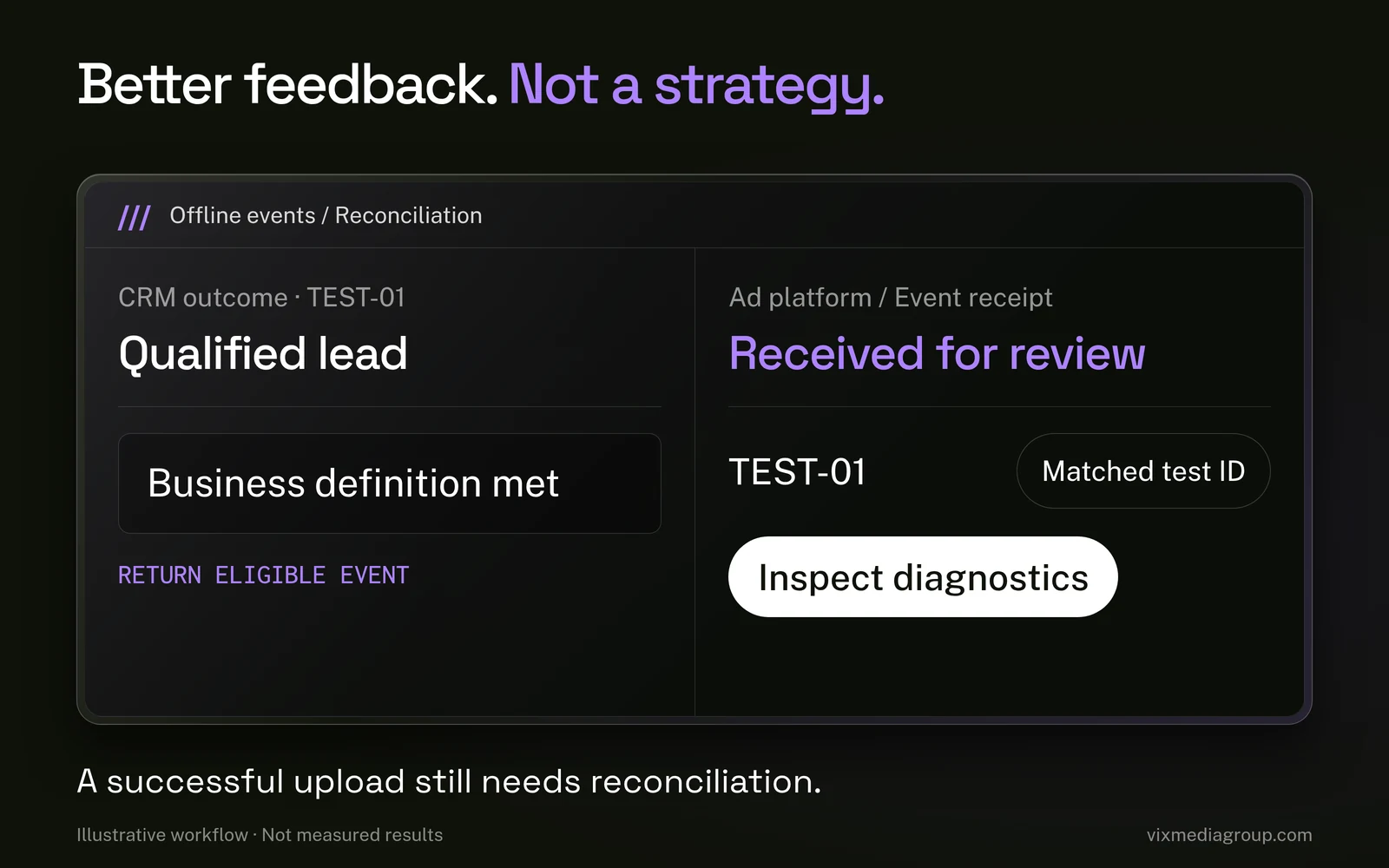
The same boundary applies to offline conversion tracking. Hashing can be part of a feedback implementation without removing the need to define eligibility, purpose, sensitivity, retention, and accountable ownership.
What should an auditable audience record contain?
An audience record should let an authorized reviewer reconstruct the decision without exposing raw customer data in planning documents. We maintain:
- A plain-language business purpose.
- The source system and data owner.
- The collection context and relevant disclosure record.
- The included, excluded, and derived field categories.
- The matching, enrichment, or modeling method.
- The destination platform and account owner.
- The sensitive-category review result.
- The platform-policy sources and review date.
- The refresh, retention, deletion, and opt-out rules.
- The approval status and conditions for reopening review.
Our data unification services help teams map these flows across systems. The purpose is not to copy identities into another repository. It is to make the movement, responsibility, and control of the data visible.
Which controls continue after launch?
Audience governance continues for as long as the audience remains available for activation. Approval at launch does not freeze the source, purpose, or platform terms.
We monitor five operating changes:
- A source begins contributing new fields or inferred traits.
- A vendor changes enrichment, retention, or subprocessors.
- An opt-out or deletion process stops propagating.
- A campaign uses the audience for a different offer or geography.
- A platform changes eligibility or sensitive-category rules.
The workflow needs a named owner who can pause activation when one of those conditions appears. It also needs deletion criteria. An audience should not remain available indefinitely simply because no one scheduled its retirement.
Audience names are part of the control surface
Names can reveal prohibited logic, imply a sensitive trait, or hide the actual source behind a generic label. We review the name and description together.
A good name identifies source class, approved purpose, geography when relevant, refresh date, and owner without including personal data or sensitive labels. The description records exclusions and the decision reference. This makes the audience understandable to operators who did not build it.
What do we test before an audience can enter a campaign?
We test more than whether the platform accepts the upload. The acceptance process verifies source membership, exclusions, opt-out propagation, refresh behavior, account ownership, and the campaign-level restriction.
We use controlled records where possible and avoid placing raw customer lists in tickets. The test evidence should show:
- Which rule was tested.
- Which synthetic or controlled input was used.
- Which behavior was expected.
- Which behavior occurred.
- Which operator reviewed the result.
- Which issue blocks activation.
A successful match count is not a complete acceptance test. It proves that the platform matched some eligible identifiers according to its process. It does not prove that every source record was appropriate for the intended campaign.
What would we change in the next audience review?
We would move the rights and sensitivity discussion before vendor selection. Teams lose time when they choose a tool, design a segment, and write creative before checking whether the input can support the intended use.
Our preferred sequence is:
- Define the campaign purpose and prohibited uses.
- Inventory potential first-party and external sources.
- Document provenance, rights, disclosures, and open counsel questions.
- Screen sensitive categories and campaign context.
- Select an eligible matching or modeling method.
- Build the auditable audience record.
- Test opt-outs, exclusions, refreshes, and deletion.
- Recheck policy sources before activation.
This sequence keeps the technical build downstream from the decision that governs it.
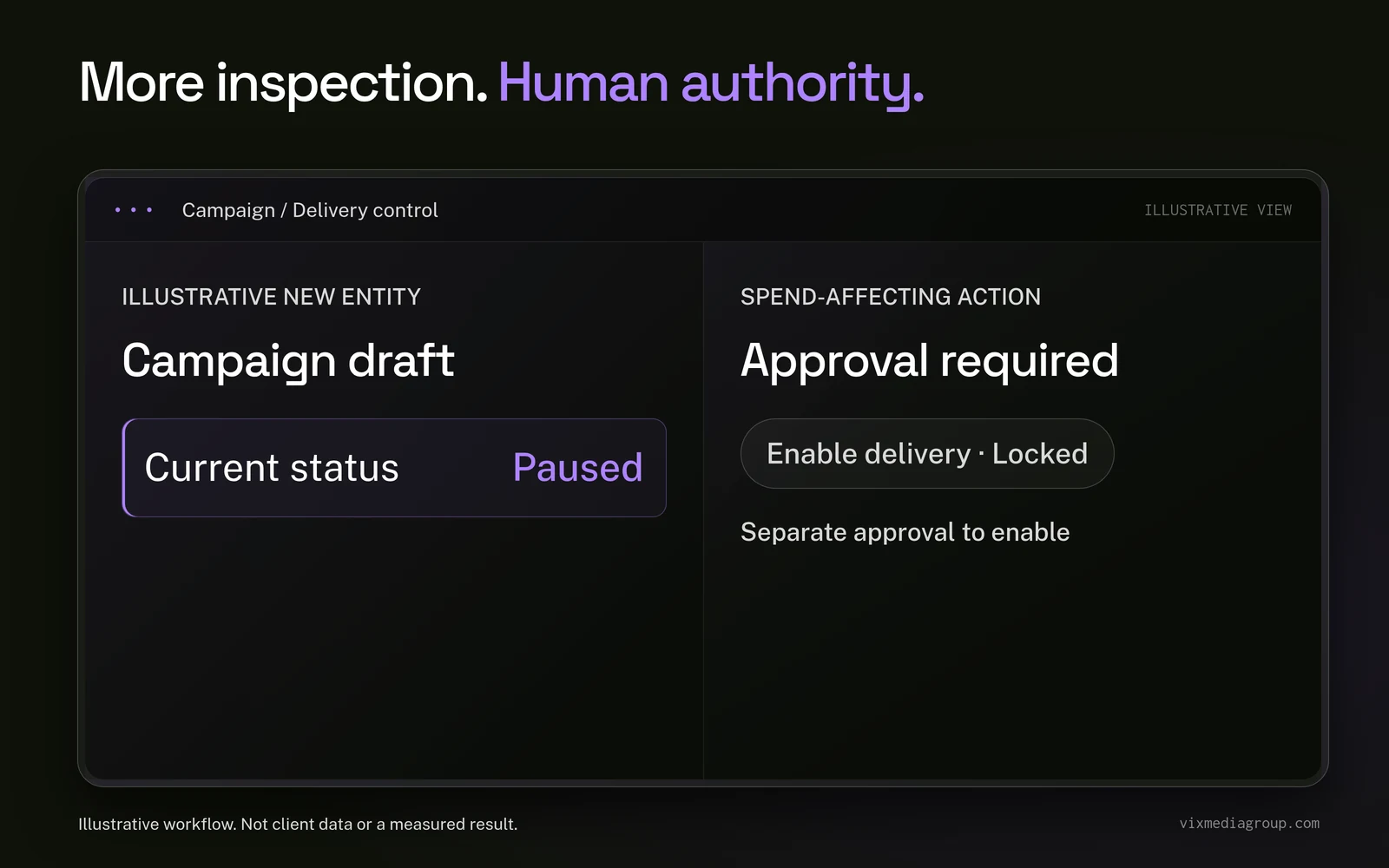
Our agentic ad management inspection model applies the same principle to execution. Automation should read approved records, surface exceptions, and preserve approval boundaries rather than silently expanding the scope of an audience.
How Vix connects audience strategy with accountable execution
Vix connects campaign strategy, data mapping, CRM structure, platform review, implementation, and ongoing inspection. Our CRM configuration services help establish source fields, ownership, lifecycle controls, and opt-out handling. Our guide to Facebook custom audiences provides practical platform context for teams working with customer-list activation.
We can document the flow, test current platform eligibility, implement bounded controls, and maintain the audit record. We do not present that operational work as a legal compliance determination. When an audience raises questions about lawful basis, consent, sensitive data, health information, consumer reports, children, automated communications, or jurisdiction-specific rights, we give counsel the facts needed to decide.
An “AI audience” is not safer or more legitimate because the model is sophisticated. The quality of the operating decision starts with the source, purpose, rights, sensitivity, and current platform rules. We make those layers visible before the audience receives budget.

.svg)



Start Growing Your Dental Practice with SEO
Take the first step toward transforming your marketing. Whether you’re looking to boost engagement, improve your online presence, or grow your business, our team at Vix Media Group is here to help.
Let’s craft a strategy tailored to your goals.