.svg)
Offline Conversion Tracking Is Valuable. It Is Not an AI Advertising Strategy
Offline conversion tracking connects later CRM outcomes to advertising. It improves measurement and feedback without replacing decisions about the offer, market, or sales process.
A campaign can look successful until the CRM sends back a harder outcome
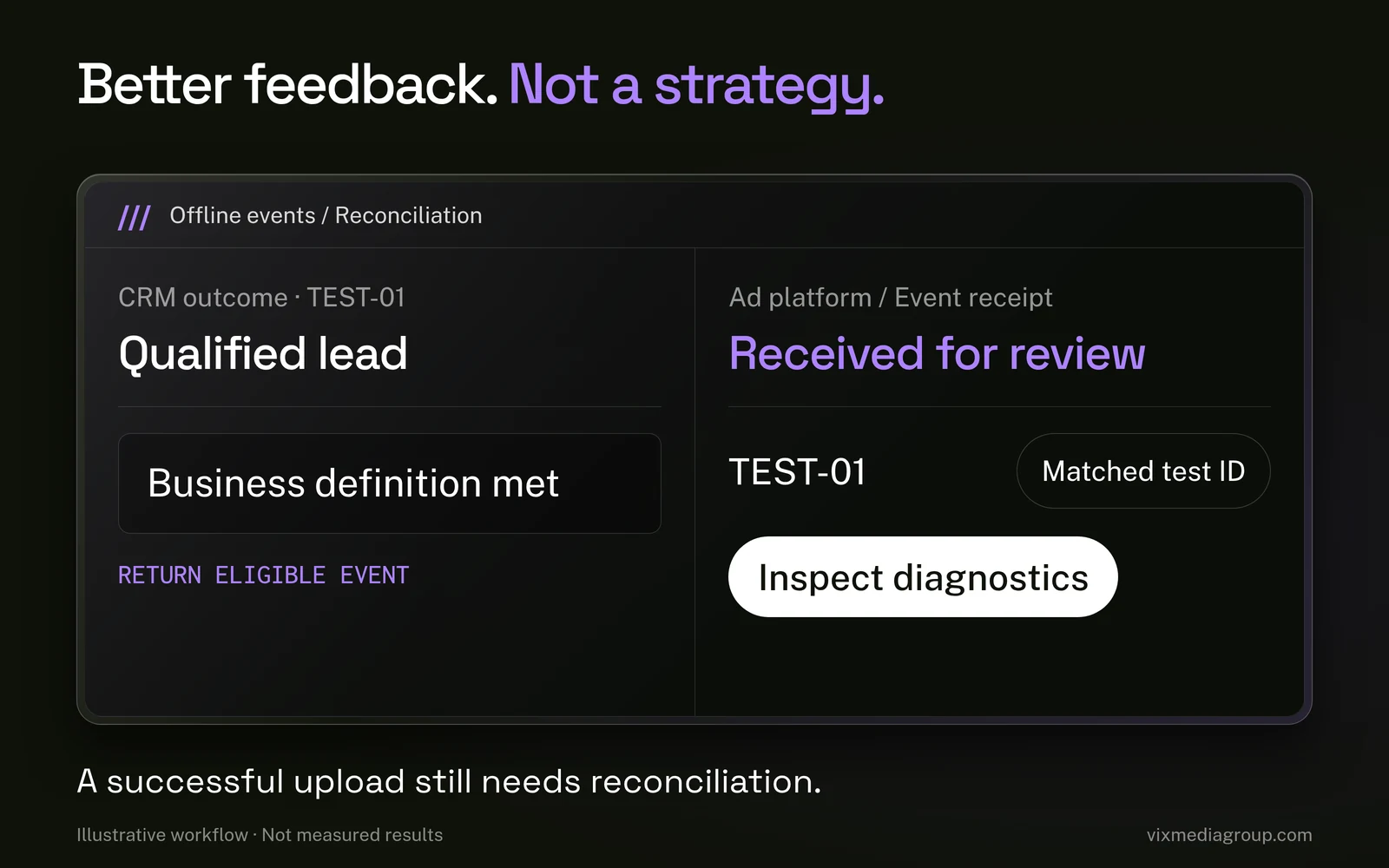
We have reviewed acquisition programs where the advertising view looked healthy at the form-fill stage, but the interpretation changed when later CRM outcomes entered the analysis. A submitted form, a qualified lead, a kept appointment, and a sale were different business events. Treating the first as proof of the last made the campaign easier to celebrate and harder to manage.
Offline conversion tracking helps reconnect those later outcomes to the advertising interaction. Our attribution tracking services build that feedback path without pretending that one imported event explains the entire customer journey. The system can improve what a platform measures and optimizes toward. It cannot decide the market, offer, message, sales process, or acceptable level of risk.
That distinction matters because the plumbing is increasingly described as an AI advertising strategy. It is not. It is measurement and feedback infrastructure that can support an automated bidding system inside a strategy owned by people.
What does offline conversion tracking actually connect?
Offline conversion tracking connects an eligible ad interaction to a later outcome recorded outside the original website conversion. The basic operating path has four parts:
- Capture an advertising interaction and the permitted attribution data associated with it.
- Preserve eligible identifiers or first-party data through the website and CRM handoff.
- Record a defined lifecycle outcome, such as qualification, attendance, purchase, or reversal.
- Return an eligible event to the advertising platform for measurement or optimization.
Google describes offline conversion imports as a way to connect outcomes that happen away from the website or later in the sales process to Google Ads. Google also says enhanced conversions for leads uses hashed user-provided data to improve attribution accuracy and bidding performance.
Meta says its Conversions API connects marketing data from servers, websites, apps, or CRMs to systems used for measurement, targeting, and optimization. Those statements describe intended platform functions. They do not establish a universal lift in conversion rate, return on ad spend, match rate, or revenue.
Why did the obvious measurement story break down?
The obvious story was that the campaign produced leads because the platform recorded forms. That view was incomplete because it stopped before sales applied its qualification criteria and before the customer completed the commercial process.
A form can be a meaningful conversion. It can also be a duplicate, a vendor solicitation, an out-of-market inquiry, an incomplete record, or a person who never responds. The platform cannot infer those distinctions reliably when the business never records them or sends them back.
Early events and business outcomes answer different questions
An early event answers whether someone completed a measurable action. A later lifecycle event answers whether that action progressed under the business's operating definitions.
We preserve both. The form remains useful for diagnosing landing-page response and campaign volume. The qualified outcome helps us understand whether the campaign reached people the business could serve. A sale or collected outcome may support a deeper economic view, but only after attribution, reversals, reporting windows, and financial reconciliation are defined.
Our approach to marketing attribution from spend to leads explains why reported activity and business causality are not interchangeable. Offline feedback narrows a gap in the record. It does not make the record complete.
Better feedback can still optimize the wrong objective
A bidding system can optimize toward the outcome supplied, so the event definition becomes part of campaign strategy. If the team cannot define a qualified lead or apply that definition consistently, it can send the platform a cleaner version of the wrong objective.
Before we make any event eligible for optimization, we create an event dictionary. Each event needs:
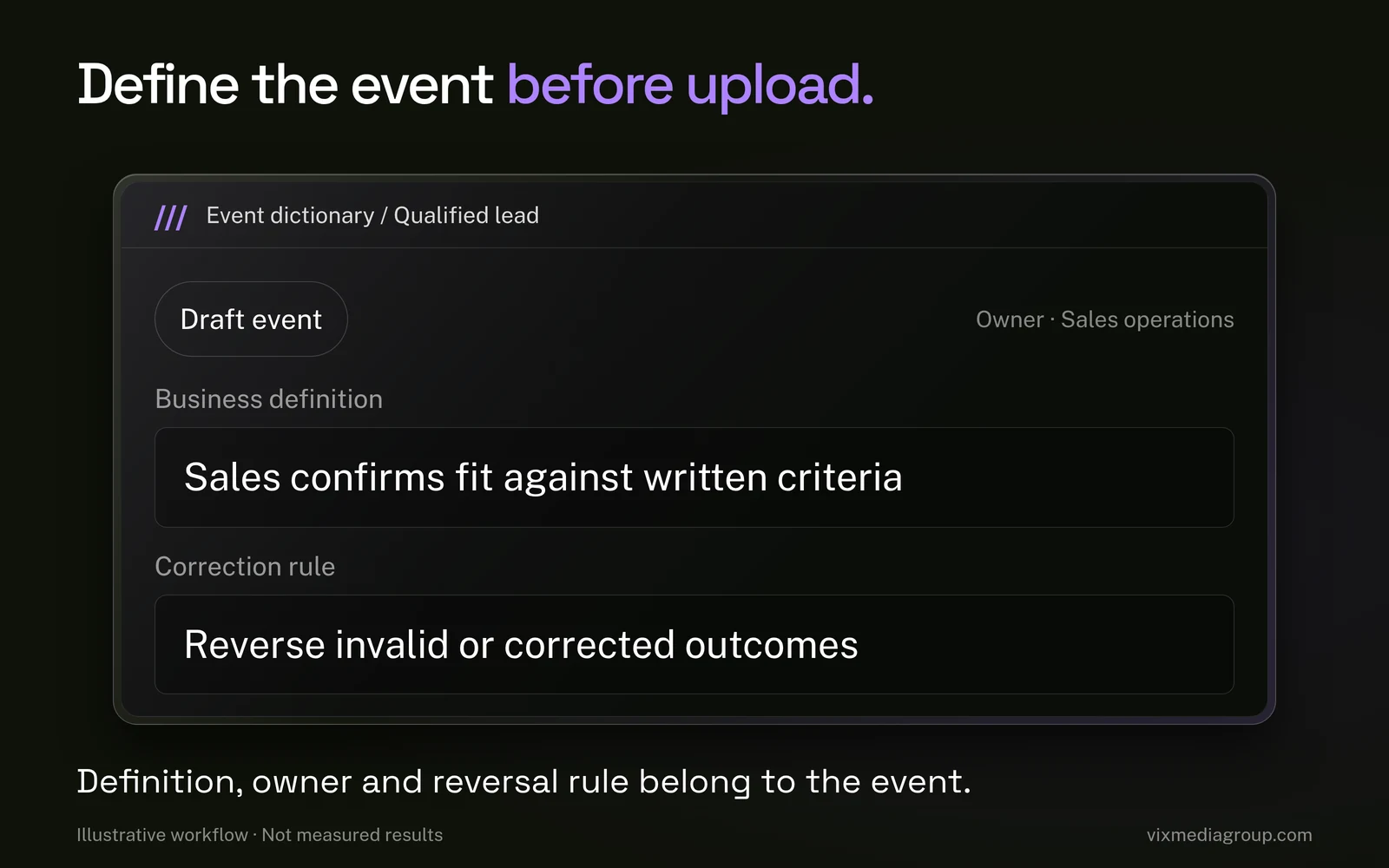
- A business definition that sales and marketing interpret the same way.
- A system of record and field that determines whether the event occurred.
- A timestamp rule that supports cohort and calendar reporting.
- An owner responsible for stage quality and exception resolution.
- A deduplication key that prevents one outcome from becoming several uploads.
- A reversal rule for refunds, cancellations, invalid records, or stage corrections.
- A platform role that states whether the event is primary, secondary, or observational.
This work often exposes a sales-process problem before it exposes an advertising problem. If two representatives use the same CRM stage differently, the upload teaches the platform an inconsistent definition. If old opportunities never close, the event volume looks larger than the usable signal. If refunds never return to reporting, attributed value can remain overstated.
Which event should guide bidding?
The event should balance business meaning with data quality, frequency, delay, and reversibility. There is no universal stage that every account should use.
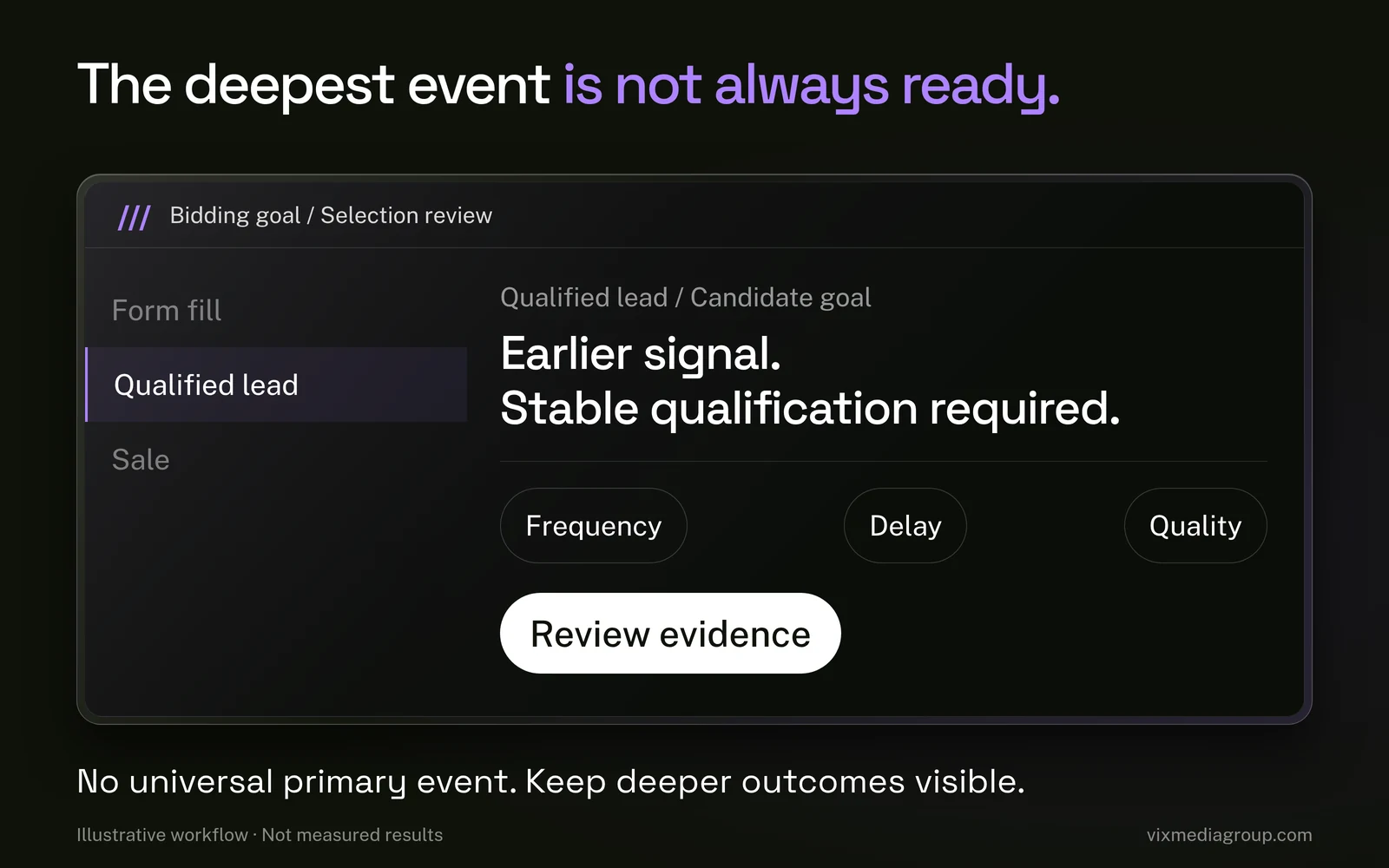
A sale can represent value clearly, but it may arrive too slowly or too rarely for a particular campaign phase. A qualified lead can arrive sooner, but only if qualification is stable. A form fill can provide volume for early learning, but it may reward campaigns that generate inexpensive records the sales team cannot convert.
We do not solve this tension by renaming an early event as revenue. We document which outcome guides bidding, which deeper outcomes remain visible for evaluation, and what evidence would justify changing the primary event. Google describes Smart Bidding as auction-time optimization toward conversion or conversion-value goals. The business still decides whether those goals represent value.
Offline feedback does not make the rest of advertising autonomous
Offline conversion tracking supplies feedback. It does not choose the commercial position or execute every decision around it.
The system does not independently decide:
- Which market and customer problem deserve investment.
- Which value proposition and offer can withstand scrutiny.
- Which creative argument and evidence should earn attention.
- Which channels and budgets fit the risk tolerance.
- Which leads sales should prioritize and how quickly it should respond.
- Which customer outcomes remain acceptable after refunds and delivery costs.
Our comparison of autonomous ad platforms separates native platform automation, vendor management layers, approvals, and operator accountability. Offline imports can strengthen one part of that architecture. They do not turn the whole commercial system into an autonomous strategy.
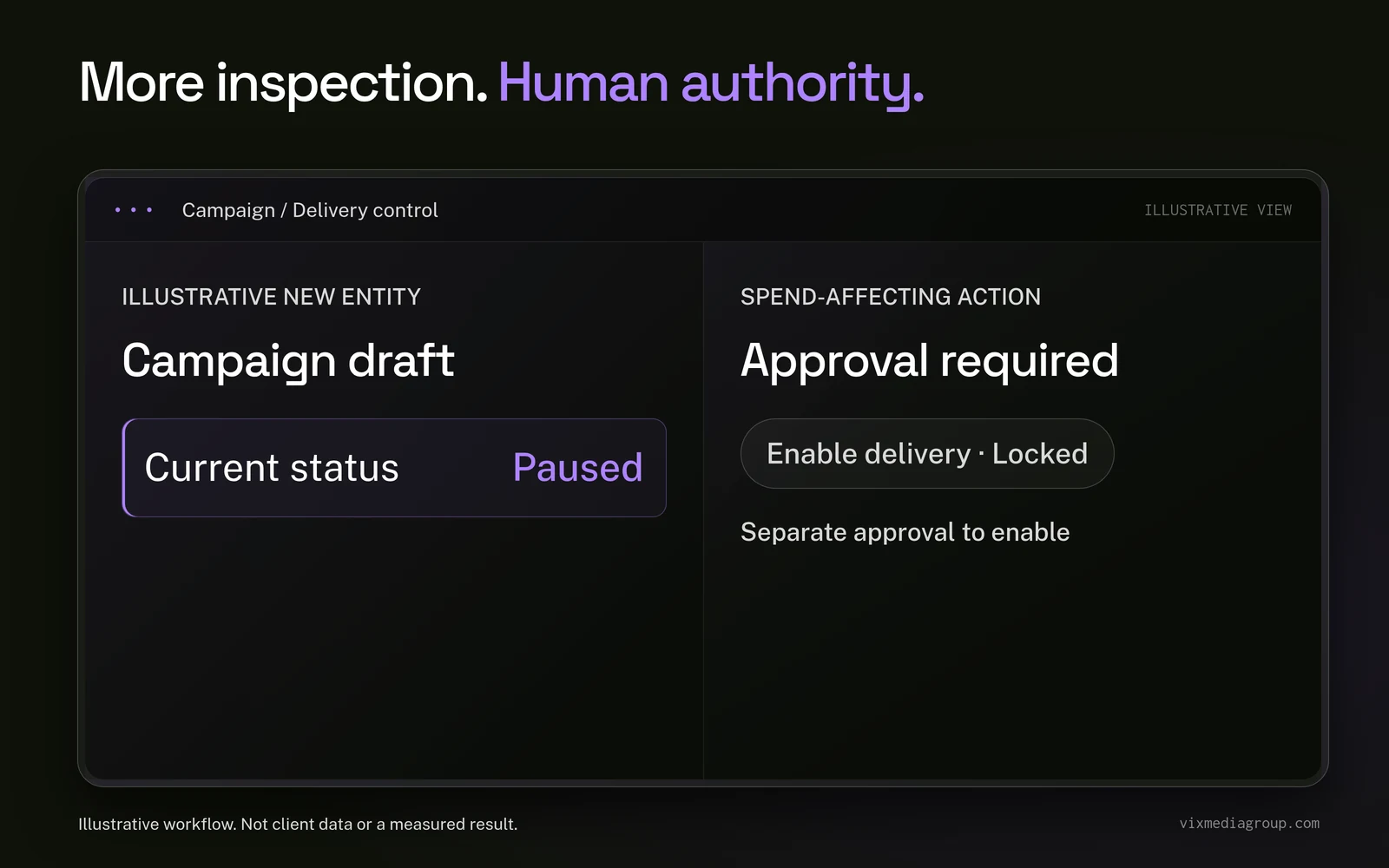
The same boundary appears in our agentic ad management inspection model. More machine-assisted inspection and feedback can expand what we evaluate, while strategy and approval remain with accountable operators.
Hashing does not eliminate data-rights or policy obligations
Hashing can support protected transfer and matching. It should not be described as anonymization, and it does not establish collection rights, consent, lawful basis, platform eligibility, or appropriate use.
We review the proposed data flow before activation. That review includes the source, collection context, fields, business purpose, destination, retention, opt-out handling, and any sensitive-category implications. Platform documentation tells us what the platform accepts under its current terms. It does not provide a universal legal conclusion.
We route questions involving lawful basis, consent sufficiency, sensitive data, sector rules, automated calling, SMS, or state privacy requirements to qualified counsel. We also recheck current platform policies before activation because eligibility can change independently of the technical integration.
What we test before the first event upload
We test the event chain as an operational system, not just an API connection. A technically successful response does not prove that the right event was sent for the right record.
Our acceptance process checks:
- Whether the website preserves permitted source data through submission.
- Whether one accepted inquiry creates the intended CRM record.
- Whether duplicates merge or remain separate according to the approved rule.
- Whether the lifecycle stage changes only when its business condition is met.
- Whether the upload maps the correct event, time, value, and currency fields.
- Whether ineligible, sensitive, opted-out, or excluded records remain outside the flow.
- Whether reversals and corrections propagate according to the documented design.
- Whether platform diagnostics and CRM totals reconcile within known limits.
We use synthetic or controlled test records where possible. The evidence log records expected behavior, observed behavior, owner, and remediation status without copying unnecessary personal data into tickets or planning documents.
What happens after activation?
Activation starts a monitoring loop. It does not close the implementation.
We review event volume, delay, match diagnostics, duplicate rates, stage consistency, reversals, and unexplained differences between the CRM and platform. We also ask whether campaign behavior changed after the deeper event became primary, but we do not assume that chronology proves causality.
A shift can come from creative, auction conditions, budget, seasonality, sales behavior, event definitions, or the feedback change itself. A defensible analysis states what changed, when it changed, and what alternative explanations remain.
Our framework for form fill to sale attribution shows how we reconcile the broader journey. Offline uploads are one return path inside that chain, not a replacement for durable capture, lifecycle discipline, sales notes, and financial records.
What would we do differently before building the next feedback loop?
We would bring sales-stage governance forward. Integration work moves faster when the business has already agreed on definitions, owners, timing, and exception handling.
Our preferred sequence is:
- Define the commercial outcome before choosing the platform event.
- Audit how the CRM currently records that outcome.
- Resolve inconsistent stages, duplicates, and stale records.
- Document data rights, platform eligibility, and counsel questions.
- Test the full path with controlled records.
- Launch the event as observational before making it a bidding goal when the account context supports that sequence.
- Establish a review cadence for quality, delay, and reversals.
This sequence prevents the integration from giving an unstable process the appearance of precision.
How Vix connects offline conversion tracking to strategy
Vix combines campaign management, CRM configuration, attribution, creative judgment, and sales-process measurement. Our CRM configuration services establish the stages and fields that make later outcomes usable. Our pay-per-click advertising services connect those outcomes to accountable acquisition decisions.
The value of offline conversion tracking is real but bounded. It can return better evidence to systems that measure and optimize advertising. It cannot define business value on its own, repair an inconsistent sales process, establish data rights, or replace the operators responsible for market, message, budget, and risk. We build the feedback loop so better decisions become possible. We do not mistake the loop for the strategy.

.svg)



Start Growing Your Dental Practice with SEO
Take the first step toward transforming your marketing. Whether you’re looking to boost engagement, improve your online presence, or grow your business, our team at Vix Media Group is here to help.
Let’s craft a strategy tailored to your goals.