.svg)
Three Autonomous Ad Platforms, Three Operating Models: What AI Ad Management Actually Automates
We compared three autonomous ad platforms by operating model, separating vendor capabilities, advertiser authority, and native automation rather than assuming equal autonomy.

We opened three vendor pages and mapped the work behind “autonomous”
Our AI ad management review began with three public product descriptions. Each vendor used language that suggested substantial autonomy, but the descriptions did not refer to one identical operating model.
We put the work on a whiteboard before evaluating the label. Planning, audience data, creative generation, campaign launch, native bidding, monitoring, approvals, and outcome measurement became separate rows. Our pay-per-click advertising services already manage those functions across people, platforms, and systems, so we needed to know which layer each product claimed to handle.
The useful question was not whether the vendors used AI. It was what the system did, what the underlying ad platform already automated, what still required approval, and who remained accountable for the result.
The distinction also changes how we evaluate implementation. Our guide to starting a digital ad campaign begins with objectives, audiences, offers, creative, tracking, and account structure because automation still needs a defined commercial system to operate inside.
The three vendor descriptions covered different scopes
The pages we reviewed came from Viant, Omneky, and Albert. They are not a representative sample of every AI advertising vendor, and they cannot support a claim about what “most” products do.
They can show that “autonomous” appears across materially different product descriptions:
- Viant calls ViantAI a fully autonomous advertising platform for the open internet.
- Omneky says its AI creative platform writes, designs, launches, and optimizes ads while also presenting an approval and launch control.
- Albert describes autonomous, self-optimizing campaign management.
These are vendor-owned statements. They establish what each vendor says about its product, not independent proof of autonomy, incremental performance, or business value.
An approval control reveals one boundary, not the whole architecture
Omneky’s approval and launch language shows that a human decision can remain in the workflow. It does not prove that the rest of the product is manual, and it does not disprove autonomous behavior in other layers.
The same caution applies to “fully autonomous.” A vendor may use that phrase for a defined product scope while the advertiser still owns market selection, business objectives, assets, data rights, policy compliance, and budget authority.
We therefore avoid scoring autonomy from one phrase. We map the actual decisions and controls instead.
Native ad platforms already automate substantial execution
A third-party AI layer does not begin from a manual advertising environment. Google’s Performance Max documentation says the campaign type uses Google AI across bidding, budget optimization, audiences, creatives, and attribution using advertiser objectives, assets, audience signals, and data feeds.
Google’s Smart Bidding documentation describes auction-time optimization toward conversions or conversion value. Native automation is already making a high volume of platform decisions within the goals and data the advertiser supplies.
Third-party value has to be located above or beside the native layer
A vendor can still add meaningful capability. It may generate and organize creative, coordinate workflows, enrich approved data, recommend plans, monitor exceptions, operate controls across channels, or make a platform easier for a smaller team to manage.
The diligence question is where that value sits. If the system primarily packages native bidding and campaign types, the buyer should know that. If it adds planning, creative iteration, cross-platform orchestration, or controlled execution, the buyer should see those functions demonstrated separately.
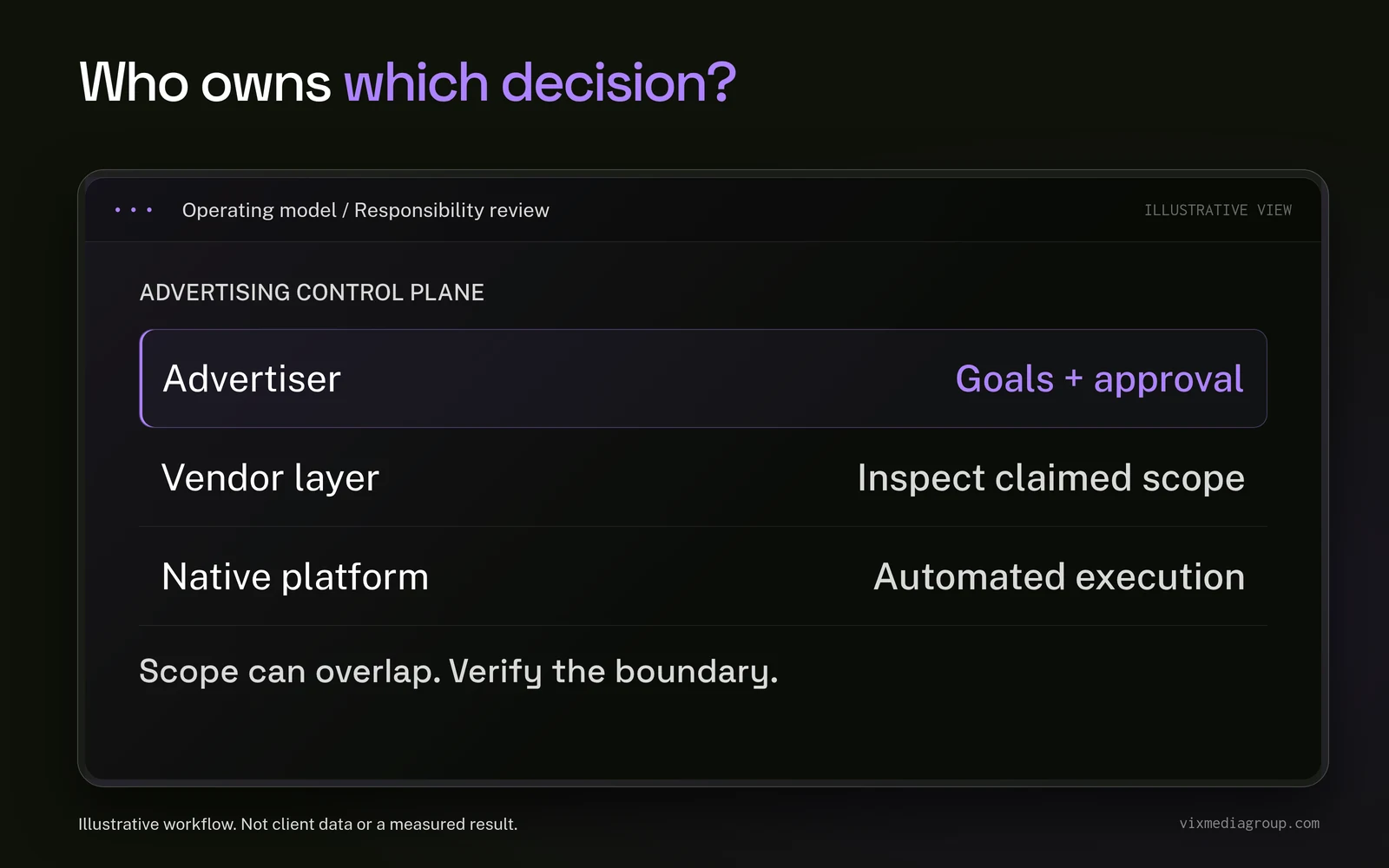
Calling the entire stack “AI-run advertising” hides the architecture a buyer needs to evaluate.
Our guide to managing a PPC campaign treats monitoring, testing, budget control, search-term review, and outcome analysis as continuing responsibilities. A vendor layer may accelerate those tasks, but its feature label does not decide which responsibility has disappeared.
We use a five-part scope test for AI ad management
Our review begins with five questions. Each one forces a product claim into an observable operating boundary.
- What approved data enters the system?
- What decisions does the vendor make independently?
- What actions occur inside Google, Meta, or another native platform?
- What requires human review or approval?
- Who owns results, policy review, and corrective action?
A useful demonstration should connect the answer to a real campaign object, visible state, or audit record. A feature list cannot show whether a recommendation was executed, whether a native platform made the underlying decision, or whether an operator can reverse the change.
Data inputs determine what the system can optimize
The system may receive business goals, creative assets, audience signals, product feeds, conversion events, budget constraints, or customer records. Each input needs an owner, a permitted use, and a quality check.
Automation can optimize toward the objective it receives. It cannot repair an undefined qualified lead, an inconsistent revenue event, a weak offer, or an ineligible audience merely by processing the input faster.
This is why measurement infrastructure and advertising strategy remain different layers. Returning later outcomes to an ad platform can improve its feedback without choosing the market, positioning, creative argument, or acceptable economics.
We separate recommendation, approval, execution, and verification
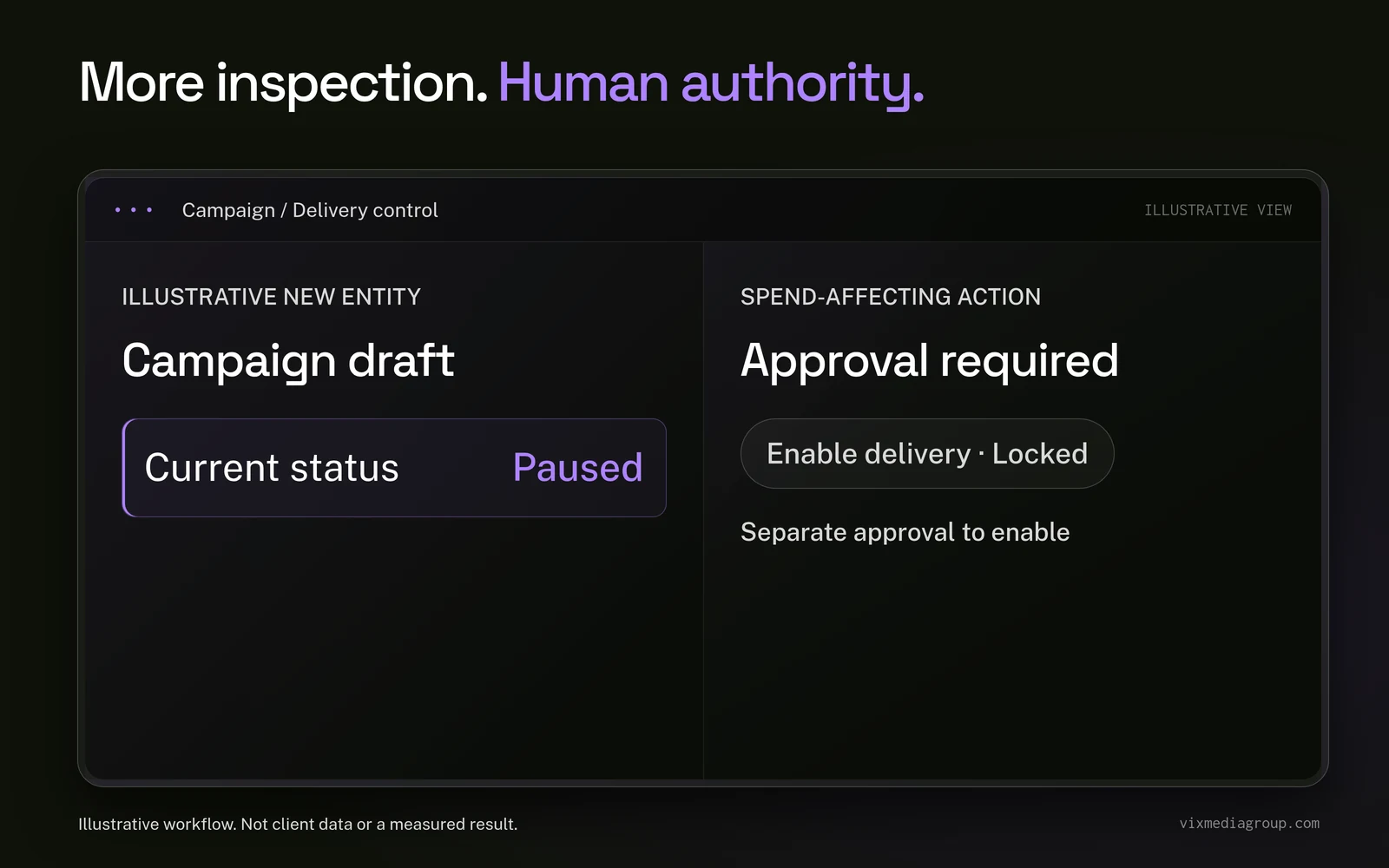
A product can analyze data and propose an action without being authorized to write it. It can execute a write without being authorized to enable spend. It can enable a campaign without proving that the campaign produced a qualified business outcome.
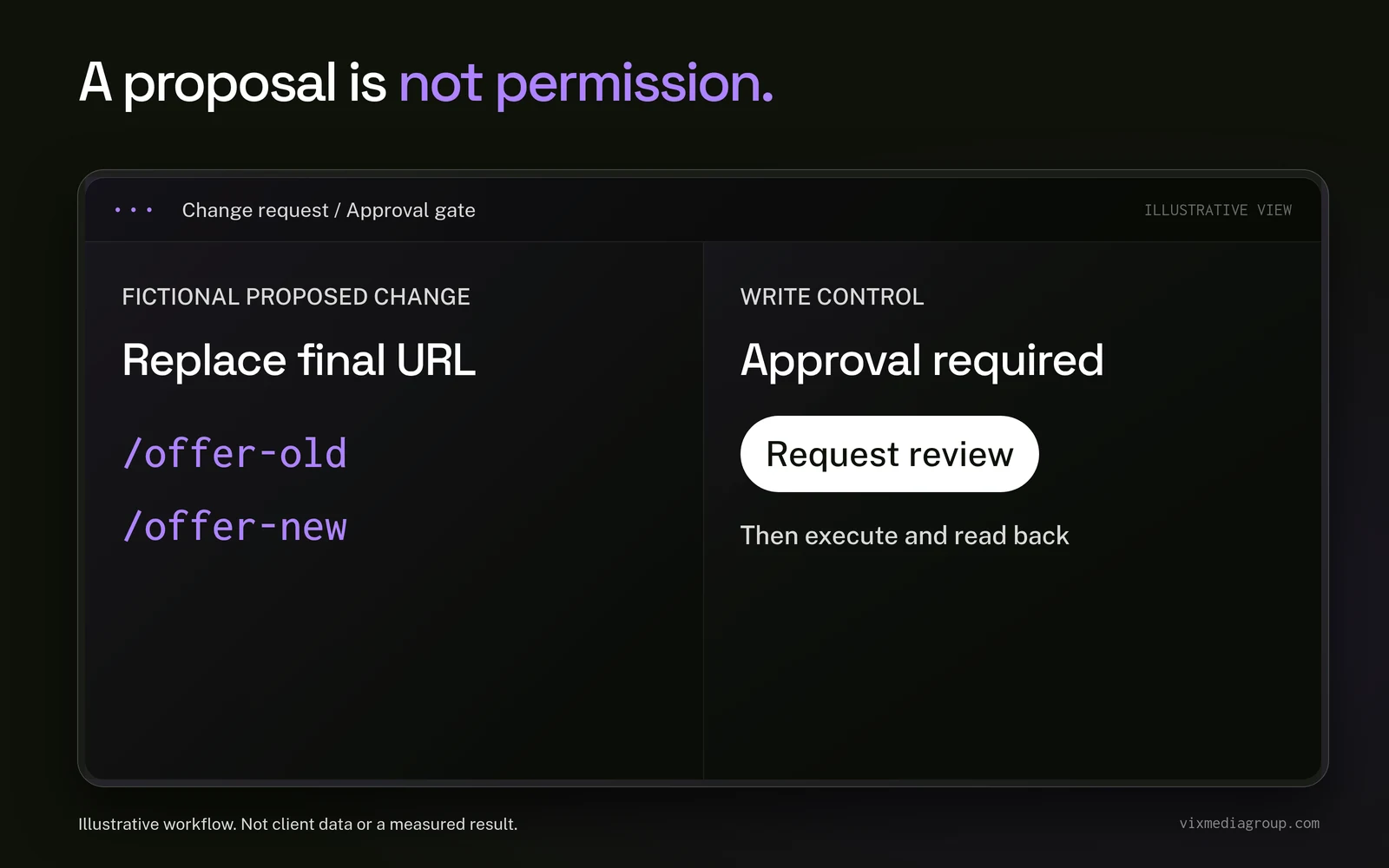
We inspect each boundary separately:
- Recommendation shows what the system believes should change.
- Approval shows who accepted the scope and risk.
- Execution shows what object actually changed.
- Verification shows whether the post-write state matches the approved action.
- Outcome measurement shows what happened after delivery.
That sequence is not resistance to automation. It is how we make automation inspectable enough to trust with media, creative, targeting, and customer-facing claims.
An actual agentic architecture needs explicit read, analysis, proposed-action, approval, execution, and verification layers. A workflow is not agentic merely because a platform uses automated bidding or a script syncs data.
Vendor performance claims require a different evidence standard
A product page can describe features and present case-study outcomes. It cannot independently validate its own incremental value.
Before repeating a performance claim as a fact, we ask for:
- The inclusion criteria and sample size.
- The analysis period and comparison period.
- The baseline, control, or counterfactual.
- The media, platform, creative, and service costs included.
- The attribution method and business-outcome definition.
- The handling of seasonality, promotions, and other campaign changes.
- Independent validation or accessible source data.
Without that support, the result remains a vendor claim. We do not convert it into a Vix finding or imply that a product will reproduce it for another advertiser.
More automation can create more management work
Automation can increase the number of campaigns, assets, audiences, bids, and recommendations a team can process. That can create useful capacity, but it also expands the inspection surface.
A team still has to evaluate market position, offer quality, creative accuracy, policy risk, conversion definitions, lead quality, and commercial economics. Faster execution can scale a strong decision or a weak assumption.
Our attribution tracking work connects platform activity to later records without treating dashboard movement as revenue. That distinction matters when a vendor demonstrates more creative or campaign activity but does not show what happened to qualified leads or sales.
What we would do differently in the next vendor review
We would request the operating-model evidence before the sales demonstration. A standard worksheet makes products easier to compare even when their language differs.
Our review would require:
- A diagram of data inputs and permissions.
- A map of native platform functions versus vendor functions.
- A list of decisions the system can make without approval.
- A demonstration of preview, pause, reversal, and audit controls.
- A sample post-write verification record.
- A documented outcome definition and attribution method.
- A failure test for missing data, conflicting goals, and policy exceptions.
Any audience workflow also needs a separate data-rights and platform-policy review. Technical access to data does not establish that the advertiser may use it for targeting.
How Vix manages the layer around automation
Vix does not treat native platform automation as fake, and we do not treat third-party AI as a substitute for management. We act as the strategy, inspection, approval, and accountability layer around the systems doing execution.
That operating role connects market and creative decisions to platform configuration, attribution, CRM outcomes, and corrective action. It gives clients a team that can explain what the system changed, why the change was approved, and what evidence followed.
Our three-vendor review does not prove what most autonomous ad platforms do. It proves that three prominent product descriptions use autonomy across different scopes and that buyers need a functional map before comparing them.
The right question is not “Does this platform run ads with AI?” The right questions are which decisions it makes, which decisions remain native, which actions require approval, and who is accountable when the evidence changes.

.svg)


Start Growing Your Dental Practice with SEO
Take the first step toward transforming your marketing. Whether you’re looking to boost engagement, improve your online presence, or grow your business, our team at Vix Media Group is here to help.
Let’s craft a strategy tailored to your goals.